
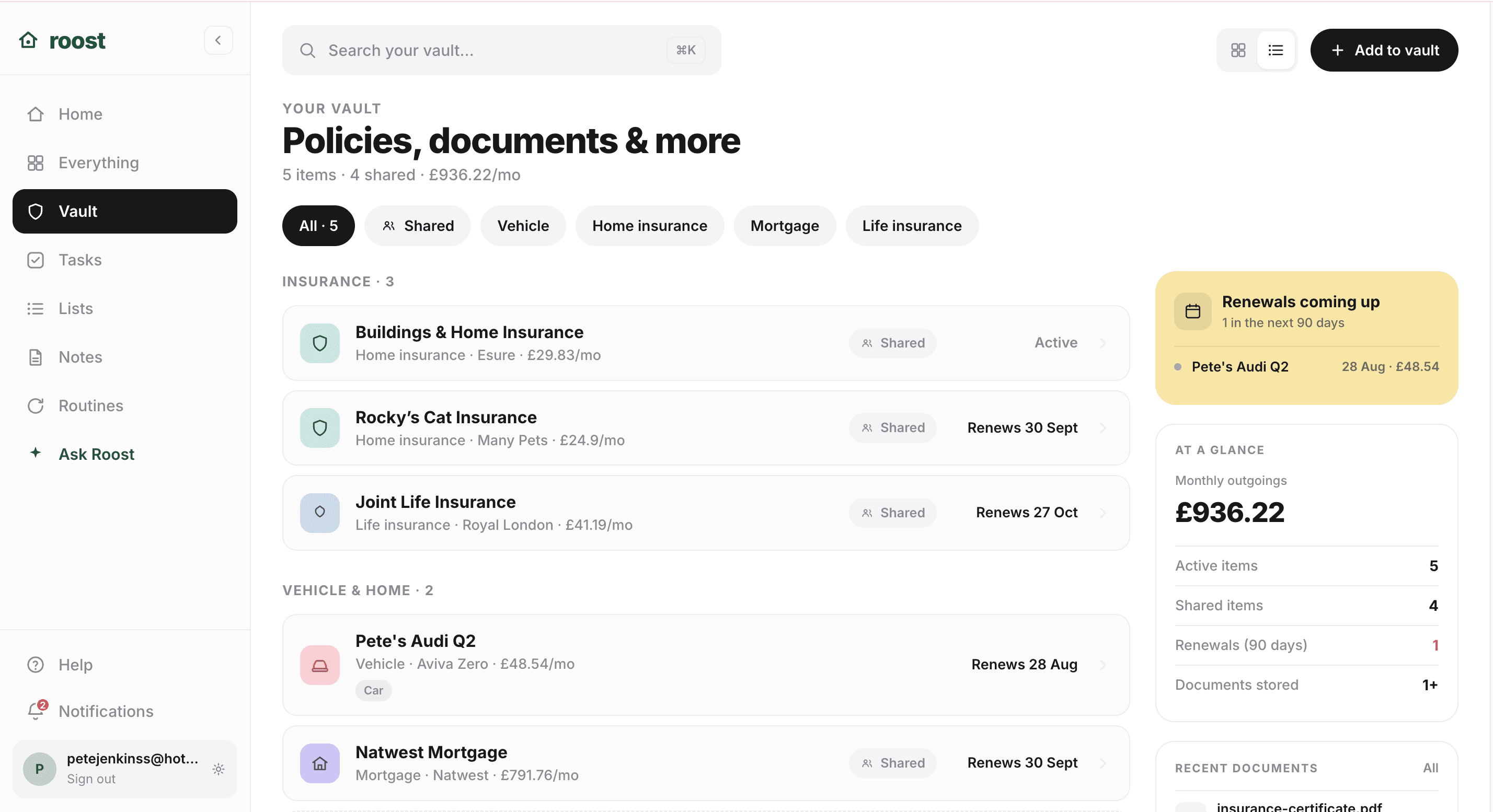
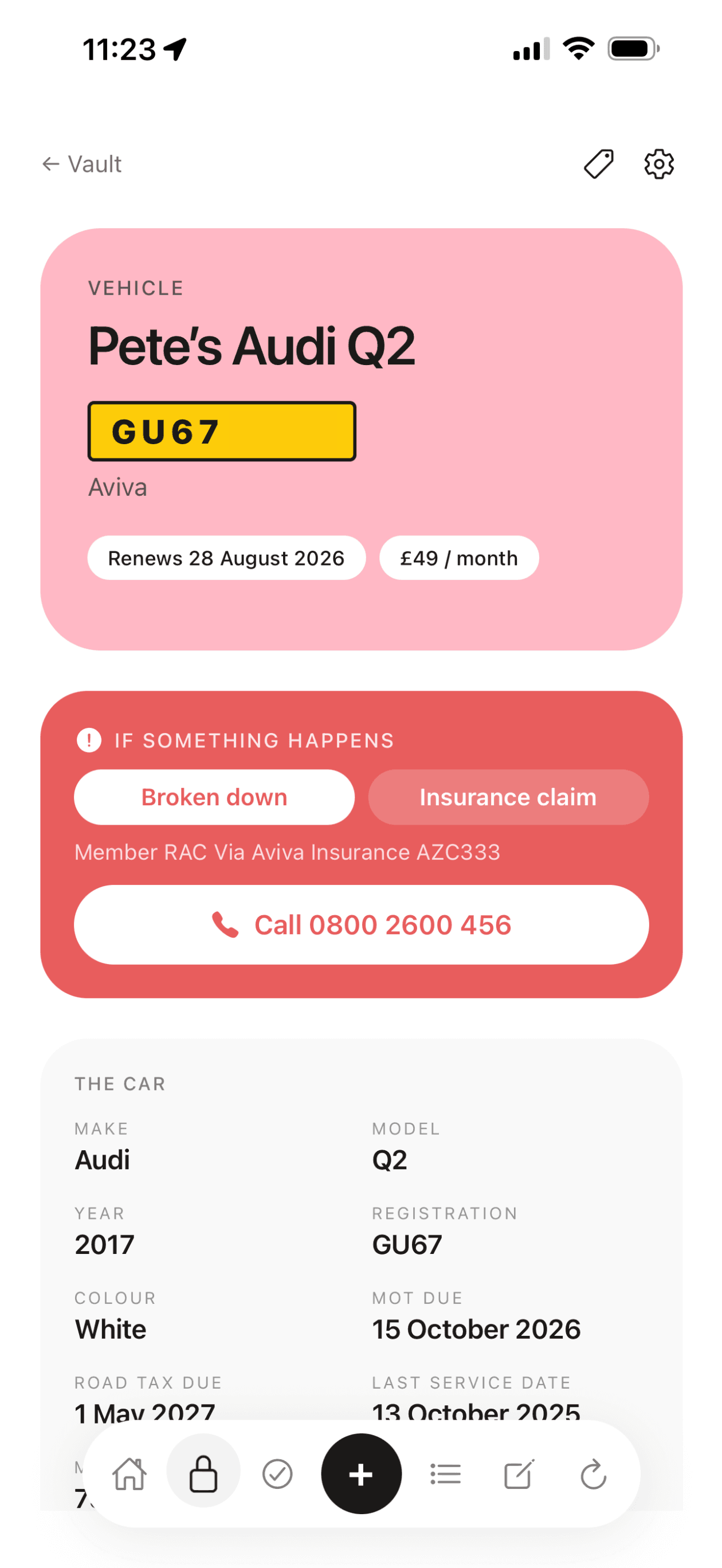
If you need to find out who your car insurance is with, the fastest starting point is askmid.com (the Motor Insurance Database), which confirms your vehicle is insured though not which insurer holds the policy. For the full details, check your email inbox for policy documents, your bank statement for the direct debit payee, or your account on any comparison site you used. Roost stores your insurer name, policy number, and renewal date in your vehicle vault so the question never needs answering twice. Here is what that looks like:
Who is my car insurance with, and how do I find out?
The quickest answer to “who is my car insurance with” is to search your email for the insurer name, check your bank statement for the direct debit payee, or log in to the comparison site you used when you last bought the policy. Between these three methods, most people can identify their insurer in under ten minutes.
Most people lose track of their insurer for the same reason: the renewal comes in, they pay without reading it closely, and another year passes. Sometimes the email address used for the original quote is an old one. Sometimes the policy was set up by a partner who has since moved out. Sometimes the cover was arranged through a broker whose renewal emails have been filtered as spam.
The result is the same: you know you are insured, but you cannot immediately say who with. That is fine most of the time. When your car is hit in a car park, you need to add a named driver, or you need to make a claim, it becomes a practical problem that needs solving quickly.
There are five reliable methods for tracking down your policy details, each suited to a different situation. The one that works fastest depends on how you originally set up the cover and which records you can access most quickly.
What does the Motor Insurance Database tell you?
The Motor Insurance Database (MID) at askmid.com confirms whether a specific vehicle is insured but does not show which insurer you are with or any policy details. It is run by the Motor Insurers' Bureau and is the database used by the police, DVLA, and other drivers at accident scenes to check insurance status.
Every UK insurer is legally required to update the MID within a set timeframe when a new policy is issued. If you check askmid.com and your vehicle does not appear, it could mean your policy has lapsed or there has been a short administrative delay. If you have taken out a new policy very recently, allow a few days for the database to update before worrying.
For your own policy, the MID is most useful as a quick sanity check that your cover is active. It will not show the insurer name, the policy number, the renewal date, or the claims line. For those, you need to find the policy documents. The GOV.UK vehicle enquiry service is a separate tool that shows MOT history and expiry dates, worth bookmarking separately.
If you are at an accident scene and the other driver cannot or will not share their insurer details, noting their registration and checking askmid.com later confirms whether they were insured. The Motor Insurers' Bureau handles claims against uninsured drivers if it turns out they were not covered.
Every insured vehicle on UK roads is registered on the MID as a legal requirement. If your car is parked outside right now and your policy is active, it is on the database.

Five ways to find out who is my car insurance with
If you are still asking “who is my car insurance with” after checking the intro, these are the five most reliable methods: searching your email, checking your bank statement, logging in to your comparison site account, looking in your vehicle's glove box or home files, and contacting a broker or specialist insurer if you used one.
1. Search your email inbox
This is usually the fastest method. Search your inbox for “car insurance”, “motor insurance”, “policy document”, or “renewal notice”. Common insurer names to search directly: Admiral, Aviva, Direct Line, LV=, More Than, Churchill, Hastings Direct, Esure, NFU Mutual. If you have changed email addresses in the last few years, check any old inboxes too. Many people set up insurance with a previous address and never updated the contact details.
The policy document is usually a PDF attachment in the original purchase confirmation or the most recent renewal email. The first page will show the insurer name, your policy number, the renewal date, and the cover level.
2. Check your bank statement
If you pay by monthly direct debit, the payee name on your bank statement is usually the insurer or their payment processor. Search the last 12 months for regular payments of the amount you associate with your premium. For an annual policy, look for a single lump-sum payment around the time you think the insurance renewed.
The payee name sometimes appears differently from the brand you know. Policies arranged through a broker are often underwritten by a different company, so the name on your statement might be unfamiliar. A quick search of that company name usually identifies the insurer and their contact details within seconds.
3. Log in to your comparison site account
If you bought your cover via Compare the Market, MoneySuperMarket, GoCompare, or Confused.com, your policy history is likely saved in your account. Log in and check your quotes history or “my policies” section. Some comparison sites store the renewal date and will email you a reminder when it approaches.
4. Check the glove box and paper files
Some insurers still send a physical certificate of motor insurance. It is a common document to misplace but worth checking your glove box, a home filing folder, or any pile of correspondence you have been meaning to sort. The certificate shows the insurer's name and your policy number, and with that you can find the claims line on their website.
5. Contact a broker or specialist insurer
If you arranged your cover through an insurance broker or a specialist scheme (classic cars, young drivers, or modified vehicles), the broker holds your records. Call or email them with your name and registration. Brokers are legally required to keep client records for a minimum period, so even if the policy has lapsed, they should be able to confirm who underwrote it.
| Method | Insurer name? | Policy number? | Renewal date? | Time | Cost |
|---|---|---|---|---|---|
| Motor Insurance Database (askmid.com) | No | No | No | 2 minutes | Free |
| Email search | Yes | Yes | Yes | 5–10 minutes | Free |
| Bank statement | Yes (payee name) | No | No | 5 minutes | Free |
| Comparison site account | Yes | Sometimes | Yes | 2 minutes | Free |
| Glove box or paper files | Yes | Yes | Possibly | Variable | Free |
| Broker or specialist insurer | Yes | Yes | Yes | 15+ minutes | Free |
Whichever method finds it, the policy schedule PDF, usually a few pages in, is what contains everything worth saving: the policy number, the renewal date, the cover level, and crucially, the claims line.

What car insurance details are worth storing?
Once you have found your policy, the most useful details to store somewhere accessible are: insurer name, policy number, renewal date, cover level, breakdown cover provider and callout number, and the claims helpline number.
Insurer name. Needed when contacting the insurer directly, rather than going through a comparison site or broker who cannot always process claims on your behalf.
Policy number. The reference number for your specific policy. You will need it when making a claim, querying your policy, or adding a named driver. It is on both the certificate of motor insurance and the policy schedule.
Renewal date. Store this somewhere you will see it well in advance, not just in the renewal email. Four to six weeks before the renewal date is the right window to compare prices. Knowing the date gives you the ability to act; not knowing it means you will probably auto-renew without checking.
Cover level. Whether you have third party only, third party fire and theft (TPFT), or comprehensive cover. This matters after an accident: third party only policies do not pay for damage to your own vehicle, even if the accident was not your fault.
Breakdown cover.Whether it is included in your car insurance or provided separately by the RAC, AA, Green Flag, or another provider, and the callout number. This is a different number from your insurer's claims line.
Claims helpline number. This is the number you need after an accident. It is different from the general enquiries line and is usually open 24 hours. Store it in your phone, and in a shared place so someone else can call it on your behalf if needed.
Keep it all in one place.
Roost stores your household details, renewal dates, and emergency info, shared with your partner. Free to start.
How do I make sure I don't miss my car insurance renewal?
The most reliable way to avoid missing your car insurance renewal is to store the renewal date somewhere independent of your insurer's emails, so you see it with enough lead time to compare prices. Four to six weeks before the renewal date is the right window: early enough to get accurate quotes, late enough that prices reflect your current situation.
Auto-renewal is the default at most UK insurers. It protects you from accidentally driving uninsured, which matters, but the price set at auto-renewal is often higher than the rate available to new customers buying equivalent cover from the same insurer. Comparison sites make switching fast, but only if you know the renewal is approaching in time to use them.
Renewal emails often arrive close to the renewal date, look like standard marketing, and are easy to ignore. By the time most people notice the direct debit has gone, the auto-renewal has already been processed. At that point you can still cancel (most UK insurers allow cancellation after renewal within a short cooling-off period), but it adds steps that could have been avoided with a diary reminder.
A calendar reminder set 45 days before your renewal date is a straightforward fix. A household admin app that surfaces renewal dates on the home screen is better still, especially if both people in the household can see it, because the person who did not arrange the original policy can also act on the reminder if needed.
If you pay by monthly direct debit, check whether your insurer auto-renews even if you do not respond to the renewal notice. Most do. Some now require you to opt in rather than opt out. Check your policy terms or call and ask directly.
The comparison sites take about 15–20 minutes to run through properly. The saving for most drivers is worth considerably more than that per hour spent.

What do I need after a car accident?
After a car accident, the information you need immediately is: your policy number, your insurer's claims helpline number, the other driver's name and vehicle registration, and photos of both vehicles and the scene. Having this information pre-saved is the difference between a stressful hour and a manageable one.
At the scene, do these things in order: check for injuries and call 999 if anyone is hurt; move to a safe position if possible; take photos of both vehicles, any damage, the road conditions, and the surrounding area; exchange details with the other driver (name, address, phone number, registration, and their insurer if they will share it); note the time, date, and location.
You are not required to accept liability at the scene. Do not apologise or admit fault, even if you think the accident may have been partly your error; that is for insurers and potentially a court to determine, not a roadside conversation under pressure.
The claims helpline is the number you need, not the general enquiries number on the back of your insurance card, which often cannot register a new claim directly. The claims line is listed on your policy schedule and is usually a different format (often freephone or a specific 0333 number). Store it in your phone contacts now, before you need it.
You should notify your own insurer even if the accident was not your fault and you do not intend to claim. Most UK policies require prompt notification of any incident. Failing to notify can affect your cover and may be treated as a breach of policy terms.
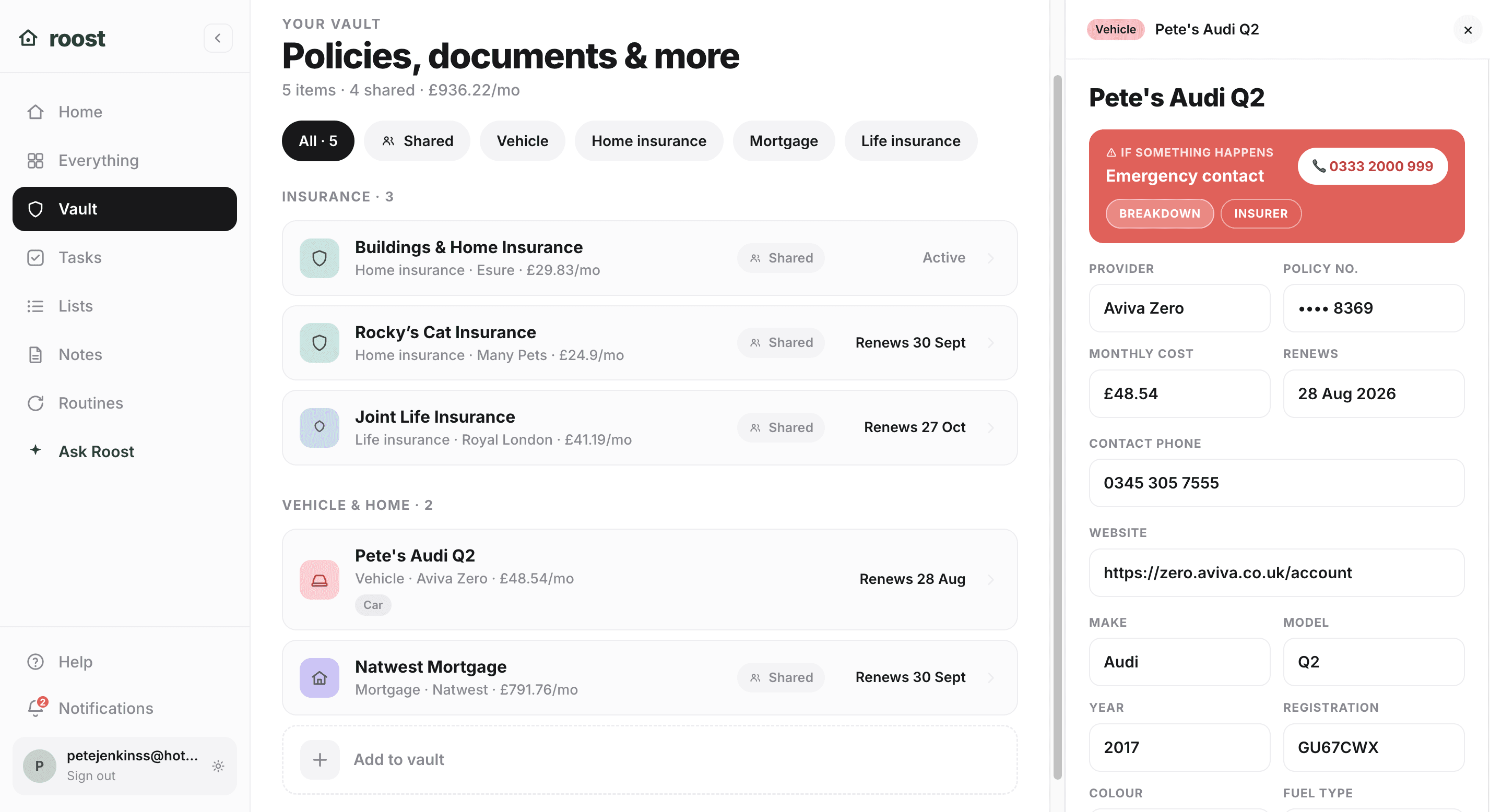
All of this (insurer, policy number, cover level, and claims line) is worth storing before an accident happens, not searching for afterwards. Roost's vehicle vault keeps it in one view, accessible from your phone within seconds:
Quick recap
- If you are asking who is my car insurance with, start at askmid.com to confirm cover is active, then email or bank statement for the insurer name
- Email search is usually the fastest way to find your insurer name, policy number, and renewal date
- The claims helpline number is different from the general enquiries line: it is open 24 hours and is the only line that registers new claims
- Auto-renewals are often priced higher than new customer rates; knowing your renewal date 4–6 weeks ahead gives time to compare
- After an accident: photos first, then the other driver's details, then call your claims line even if you do not plan to claim yourself
- Roost stores insurer, policy number, renewal date, cover level, and claims number per vehicle, shared with your household
How to never have to look this up again
Every method above works once. The reason you are reading this is that the answer was not written down anywhere you could find it, and unless something changes it will not be written down next year either. The fix is dull and takes about four minutes: put the insurer, the policy number, the renewal date and the claims line somewhere you and whoever you live with can both reach, then set a reminder six weeks before the renewal so you are comparing prices rather than auto-renewing.
If you want to weigh up where to keep it, we compared the best life admin apps in the UK and looked separately at the apps that actually remind you before a renewal. Both cover Roost alongside the alternatives, including the free ones.
Frequently asked questions
Can anyone look up who insures my car?
Anyone can check whether a specific vehicle is insured via the Motor Insurance Database at askmid.com. This is how the police and DVLA verify insurance status at accident scenes. However, the MID only confirms that a vehicle is insured; it does not show which insurer you are with, your policy number, or any other details. Your insurer will not discuss your policy with a third party without your consent.
What happens if I drive without insurance in the UK?
Driving without valid insurance is a criminal offence under the Road Traffic Act 1988. The minimum penalty is a fixed penalty of £300 and 6 points on your licence. Courts can impose unlimited fines, disqualification, and vehicle seizure. Most insurers auto-renew, but if a direct debit payment fails and you are not alerted, your policy can lapse. Check askmid.com if you are unsure whether your vehicle is currently insured.
What is the difference between the claims line and the general enquiries line?
Your policy document lists both numbers. The general enquiries line handles quotes, policy changes, and account questions. The claims line is open 24 hours at most major insurers and is the only number that can register a new claim immediately after an incident. Store the claims number in your phone before you need it; it is the number that matters at the roadside, not the general sales line.
How long does a car insurance claim take to settle in the UK?
Straightforward claims where liability is clear can settle in a few weeks. Disputed liability cases can take several months. Personal injury claims can take longer still. The key is notifying your insurer promptly. Delays in reporting can affect your cover and complicate settlement.