
The mental load is the invisible cognitive work of tracking, planning, and remembering everything a household needs: renewal dates, the plumber's name, when the boiler was last serviced, which bin goes out this week, and where the insurance documents are. In most households, one person holds this operational knowledge while the other relies on it. Roost was built to externalise that map into a shared system both people can access.
What is the mental load?
The mental load is the ongoing cognitive labour of anticipating and managing a household's operational needs. It is the background process of remembering that the car insurance renews in three weeks, that the boiler was last serviced eighteen months ago, that the emergency plumber's number is saved on your phone but your partner does not know where, and that the dog's next vet appointment is on a date nobody has added to a shared calendar.
It is distinct from physical chores. The person who does the cooking may still need to ask where the pots are kept. The person who takes the bins out may still rely on a reminder to know which bin goes out when. Physical tasks are visible and delegatable. Cognitive tracking is easier to carry invisibly, without the other person realising anything is being held.
The mental load is also cumulative. Each piece of household knowledge takes a small amount of mental space. Taken together, knowing where everything is, what is coming up, what needs doing, and who to call when something goes wrong takes significant cognitive bandwidth. This adds up quietly over months and years, and tends not to reduce when life gets busier.
There is also an anticipatory dimension. The person carrying the mental load is responsible not just for remembering, but for knowing that the annual boiler check needs booking before winter, that the car insurance will auto-renew at a higher price if nobody shops around, and that the school photo day requires clean uniform two days in advance. This forward-looking labour is the hardest part of the mental load to name, and the hardest to share.

Why does the mental load fall to one person?
The mental load usually falls to one person because of how households are built, not because of deliberate unfairness. One person starts handling something, develops fluency with it, and becomes the household's default resource for that domain. The other person comes to rely on them, not through laziness, but because asking is always more efficient in the short term than rebuilding knowledge you do not have.
This creates a self-reinforcing pattern. The person who knows becomes the person who is asked. The person who is asked develops more fluency. Their partner becomes less practised. Over time, the gap widens without either person making a conscious choice to widen it.
The pattern often starts early in a relationship, when one person takes on the task of knowing something once, and it quietly becomes their permanent responsibility. The longer it goes without being named, the more invisible it becomes to the person who is not carrying it. From the outside, it can look as though the person carrying the mental load simply prefers to manage these things. From the inside, it is less a preference than a default that has never been renegotiated.
What does the mental load actually cover?
The mental load covers everything a household needs someone to know, track, and anticipate. Most of it is invisible to the person who is not carrying it. Here is a breakdown of the most common categories:
| Category | What it typically includes |
|---|---|
| Insurance and finance | Policy numbers, renewal dates, comparison sites used last time, direct debits, excess amounts |
| Home and maintenance | Boiler service history, plumber contact, broadband contract end date, when gutters were last cleared |
| Health and wellbeing | GP and dentist appointment schedules, repeat prescription dates, out-of-hours service number, children's vaccination records |
| Household operations | Which bin goes out when, where the stopcock is, smoke alarm battery schedule, recycling collection day |
| Events and planning | Birthday dates, school events, holiday bookings, anniversary plans, family commitments |
| Emergencies | Insurance claims numbers, which emergency number to call for what, what to do if the boiler breaks, where the fuse board is |
What this table makes clear is that most of the mental load is information-based rather than task-based. The tasks are visible: someone takes the bins out, someone books the boiler service. The knowledge required to handle those tasks correctly, at the right time, with the right contact details, is largely invisible. And it tends to live in one person's head.
What does the research say about the mental load?
Research on the mental load consistently shows it falls disproportionately on women. A study accepted by the British Journal of Political Science found that women carry approximately 71% of a household's cognitive labour. Research from Harvard Business School found that the gap in cognitive household work is roughly twice the gap seen in physical chores: couples who split physical tasks fairly may still have a significant imbalance in who tracks, plans, and anticipates.
The ONS data on unpaid household work in the UK shows that women spend an average of 26 hours per week on unpaid work compared to 16 hours for men. That gap is wider than the gender pay gap for employed workers and has closed much more slowly. The mental load component is harder to measure directly but is widely considered to represent a significant proportion of that total.
The term became widely known in 2017 following a viral comic by journalist Emma, which gave language to a pattern many people recognised but had not previously named. A 2019 study in Sociological Methods and Research found that the cognitive dimension of household labour had a measurable negative impact on wellbeing, independent of the time spent on physical tasks. This distinction matters: it means that splitting chores does not automatically fix the mental load, because the load is not primarily about doing. It is about knowing.

7 ways to share the mental load more fairly
These seven approaches address both the information dimension of the mental load (who holds the household's knowledge) and the social dimension (how the default got established in the first place). They work best used together rather than in isolation.
1. Make the invisible visible
Before any conversation about fairness, write down every piece of household information you currently hold: every policy number, renewal date, contact name, and operational default that lives in your head. Show the list to your partner. The concrete list does more than any abstract description of the problem. It is difficult to argue that the mental load is shared equally when one person can produce a list of fifty items the other person could not locate without help.
2. Assign domains, not tasks
Task-sharing is splitting the cooking and the laundry. Cognitive domain ownership is one person taking full responsibility for the vehicle admin: knowing when the MOT is due, which garage you use, what the insurance claims number is, and handling the renewal when it comes up. Domain ownership is more sustainable than task-by-task negotiation because it transfers the cognitive tracking, not just the doing.
3. Build a shared information system
A conversation about the mental load is not a system. Both people need a single place to look up household information without asking. This could be a shared folder, a household admin app, or a well-maintained notes document. What matters is that both people add to it and both people use it. If only one person maintains the system and the other treats it as an alternative to asking, the cognitive load has simply moved rather than been shared.
4. Stop being the answer
When your partner asks you something that should be in your shared system, point them to the system rather than answering directly. This is less efficient in the short term and significantly more sustainable in the long term. It builds your partner's familiarity with the household's information rather than reinforcing their habit of relying on you. It feels harder than just answering. It is harder. It is also how the load actually shifts.
5. Schedule a regular household review
A short monthly check-in, fifteen or twenty minutes, to look at upcoming renewals, anything that needs booking, and any information that needs updating in your shared system. The goal is not to have a meeting. It is to make sure both people are actively reviewing the household's operational state, not just one person. Over time this builds a shared mental map rather than one held in a single person's head.
6. Accept a transition period
The person who did not previously hold the household's information map will need time to build the habit of looking things up, adding information, and taking on cognitive ownership of their domain. This is normal. Rebuilding the system for them the first time they struggle with it defeats the purpose. The transition period is where the actual load transfer happens, and it requires the person who previously carried everything to resist the instinct to simply handle it themselves.
7. Name the problem specifically
The mental load is hard to fix if it is not named clearly. Both people need to understand that the issue is cognitive, not just practical, and that the goal is for both to be able to find and act on household information without asking. General appeals for the other person to “do more” do not address the knowing dimension. The conversation needs to be specific: what information does one person hold that the other cannot currently access, and what would need to change for that to be different?
Keep it all in one place.
Roost stores your household details, renewal dates, and emergency info, shared with your partner. Free to start.
Can an app genuinely help with the mental load?
An app can help with the information dimension of the mental load, but not the social one. If the problem is that one person holds all the household's policy numbers, renewal dates, and emergency contacts in their head, moving that information into a shared digital system directly reduces the load. The other person can find what they need without asking. The question “who is our boiler engineer?” now has an answer that does not require interrupting anyone.
What an app cannot fix is the dynamic that created the imbalance in the first place. If one person is still the default for noticing what needs doing, adding things to the system, and maintaining it, the cognitive gap persists in a different form. The app works when both people use it actively, not when one person maintains it and the other uses it as a more convenient way of asking.
Here is what a shared household information system looks like when both people are actively using it to store and access the details that usually live in one person's head:
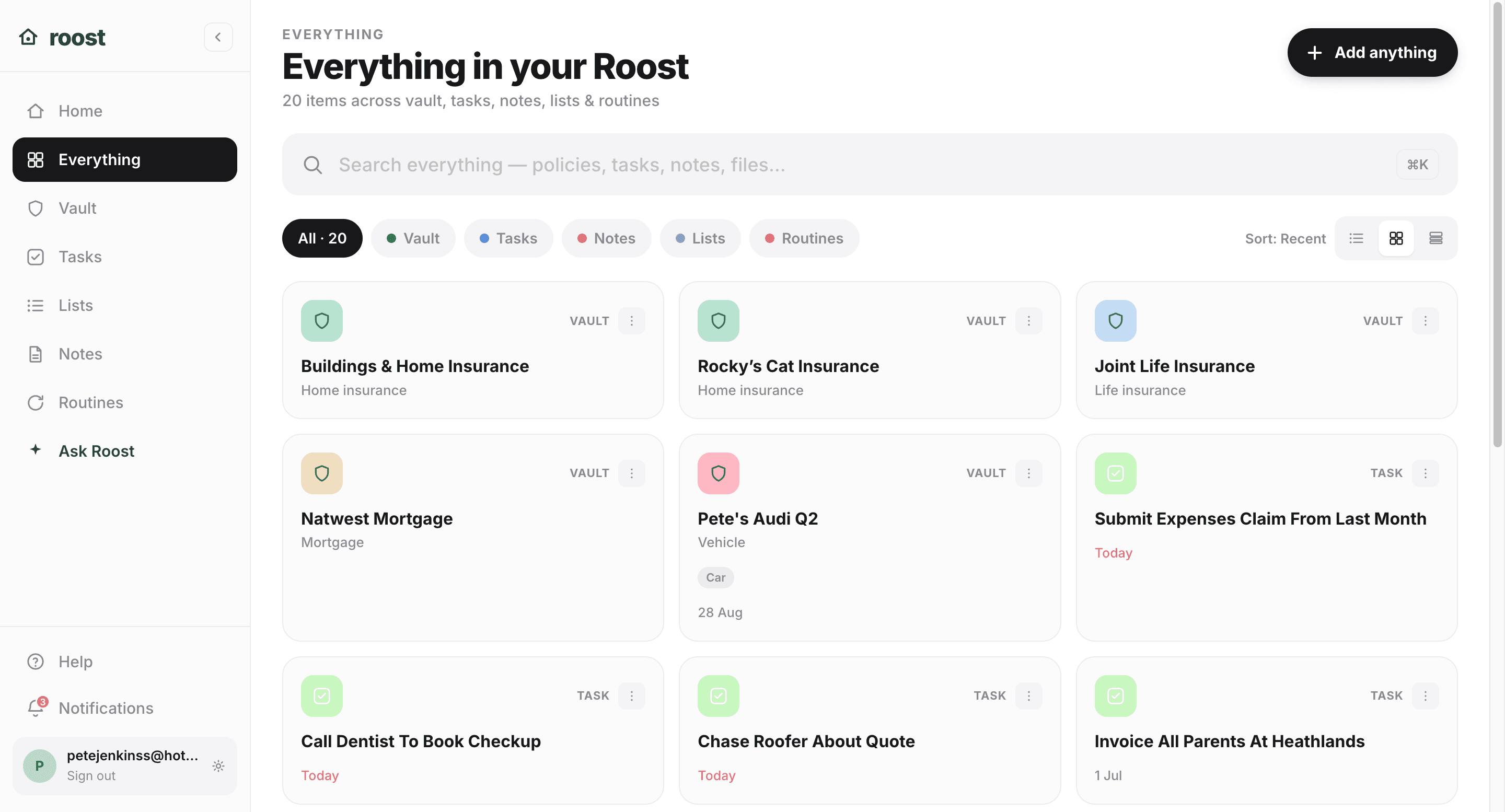
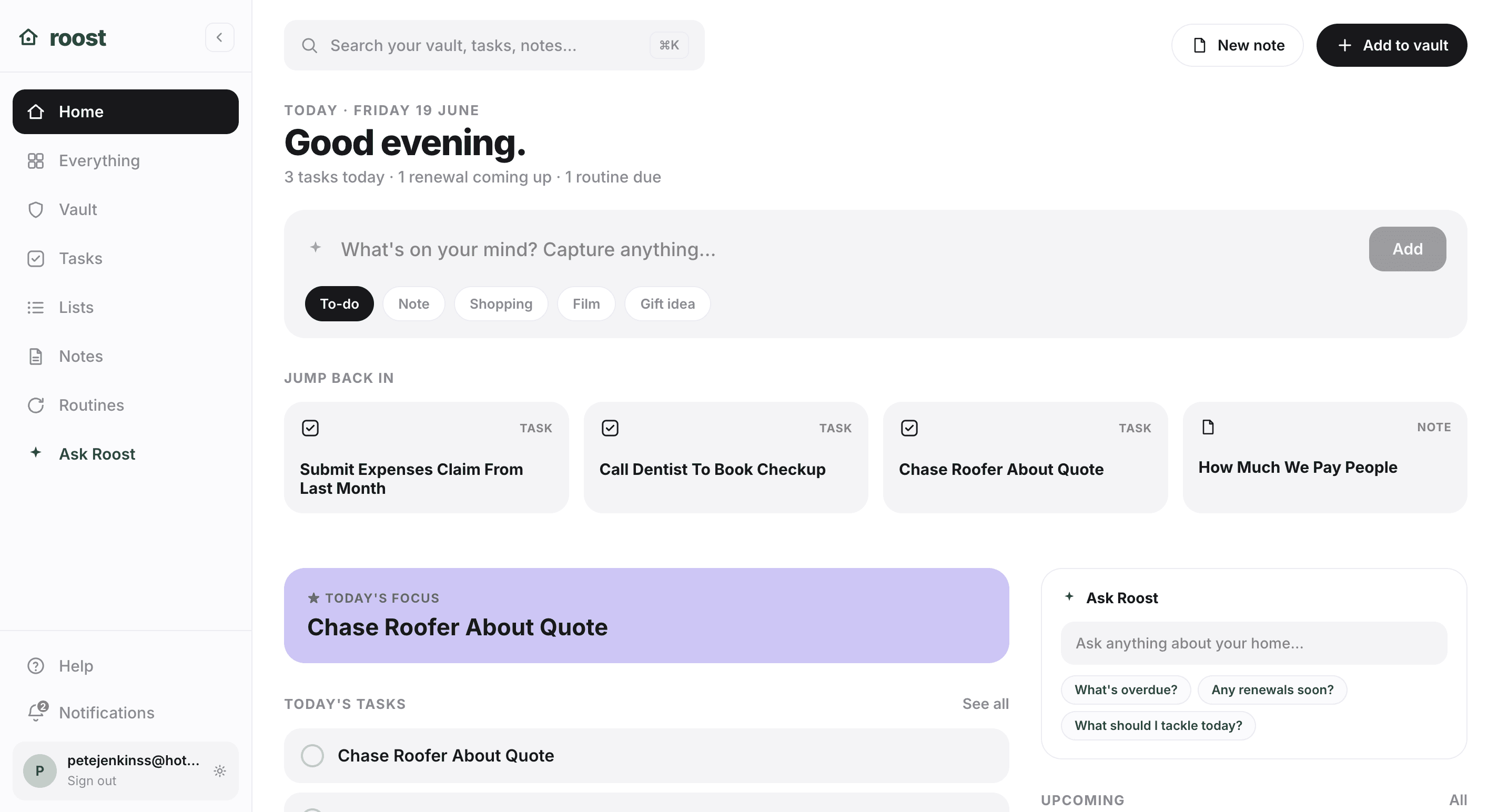
The Roost vault stores the information that drives most of the mental load: insurance details, renewal dates, emergency contacts, and home maintenance records. Each vault item includes an “If X happens” section, storing what to do and who to call in an emergency, so the person who did not set it up can still act on it without asking. Renewal reminders surface upcoming policy renewals on both people's home screens, and routines track recurring household tasks so neither person has to hold the schedule in their head.
What does not help with the mental load?
Several commonly suggested approaches do not address the underlying problem, and are worth naming clearly so you do not spend energy on them.
Asking for help does not work on its own. It shifts the doing but not the knowing. If your partner has to ask you what needs doing, you are still carrying the cognitive load for noticing and delegating. You have become a project manager rather than a participant.
Splitting a chore list does not fix cognitive tracking. The person who takes on the cooking and cleaning is not automatically the person who starts holding the household's renewal dates, emergency numbers, and operational knowledge. A chore split addresses physical tasks. The mental load is a separate layer.
A single conversation rarely creates lasting change. The mental load is a structural feature of how a household operates, not a feeling that resolves when it is acknowledged. Awareness without a system change produces temporary improvement at best, and frustration when the same pattern reasserts itself.
Criticising the imbalance without offering a practical alternative puts the person who is not carrying it in an impossible position. The conversation is more useful when it is diagnostic and practical: here is the information I hold, here is a system we could both use, here is a domain you could own.
How to talk about the mental load with your partner
The most useful opening is to make the invisible visible before the conversation starts. Write a list of every piece of household information you currently hold, then bring it to the conversation and ask one question: how much of this could you find without asking me? In most households the answer is very little. That is not an accusation. It is the diagnosis, and it shifts the conversation from “is this fair?” to “how do we fix this practically?”
Be specific about what you are asking for. Not “I need you to do more” but “I need you to take full ownership of the vehicle admin: knowing when the MOT is due, handling the insurance renewal, and being the person both of us call in a breakdown.” Domain ownership is specific and sustainable. General appeals for more engagement are not.
If your partner is sceptical about the concept of the mental load, the list is usually more effective than the concept. A concrete list of forty pieces of household knowledge, of which they can immediately locate roughly five, is harder to dismiss than a description of invisible labour. The list turns an abstract conversation into a practical one.
Frame it as a practical problem rather than a moral failing. The person who is not carrying the mental load did not choose not to carry it. The pattern formed without a deliberate decision on either side. The question is not who is to blame but how the household's information can be genuinely shared going forward.
Building a shared household information system
Once both people are committed to building one, the goal is a single shared place where both can find the household's operational information without asking. The simplest version is a shared folder with one document per category. A more structured version is a household admin app designed specifically for this, which organises information by section, surfaces renewal dates automatically, and stores emergency contacts alongside the policy they relate to.
Whatever system you choose, three rules apply: information goes in when it arrives, not when you get round to it; both people must actively add to and read from the system; and the system needs to cover the categories that drive most of the mental load: insurance, maintenance, finance, health, and emergencies.

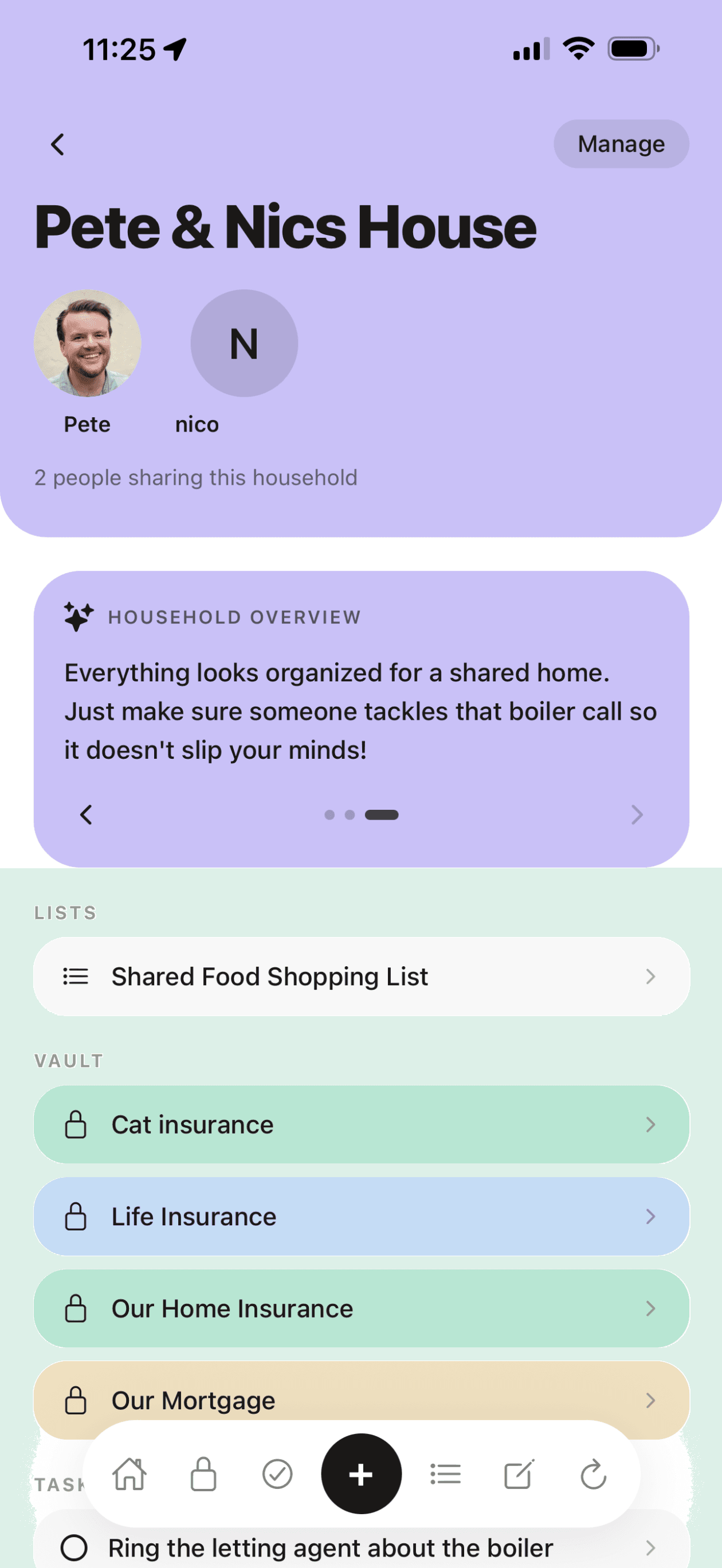
Once the information is in a shared system, here is what it looks like to have every section accessible to both household members at once:
The test of whether a system is working is simple. If your partner can answer “who is our home insurer and when does it renew?” without asking you, the mental load for that item has been genuinely shared. If they still need to ask, the information is still only in one person's head, regardless of which system you are using.
Quick recap
- The mental load is the cognitive work of tracking, planning, and knowing, not just the physical work of doing
- It falls to one person because of how households build their information maps over time, not because of malice
- Research shows women carry around 71% of cognitive household labour, roughly twice the gap in physical chores
- Making the invisible visible is the first step: write down everything you know, then build a shared system
- An app can solve the information dimension; the social dynamic requires both people to actively use the system
- The test is whether your partner can find what they need without asking you
Frequently asked questions
What is the mental load in a relationship?
The mental load is the cognitive work of tracking, planning, and anticipating everything a household needs. It includes remembering renewal dates, knowing where documents are, booking appointments, and holding the operational knowledge of how the home runs. It is distinct from physical chores: someone can share the housework while still relying on their partner to carry this cognitive map.
Is the mental load always one person's burden?
Research consistently shows women carry a disproportionate share of the mental load. A study accepted by the British Journal of Political Science found women carry around 71% of cognitive household labour. The pattern is not universal, but the underlying driver is usually who built the household's information map first, and whose default it became to maintain it.
How do you explain the mental load to your partner?
The most useful approach is to make the invisible visible. Write down every piece of household information you currently hold: policy numbers, renewal dates, the boiler engineer's name, which bin goes out when. Show your partner the list and ask how much they could find without asking you. In most households the answer is very little. That list does more than any abstract description of the problem.
What is the best way to track shared household information?
A shared digital system works better than conversations alone because it gives both people access to information without either having to ask. The key is a single place where policy numbers, renewal dates, emergency contacts, and household reference information are all stored together. A household admin app like Roost is designed specifically for this. General tools like Google Drive work but require more discipline to maintain a consistent structure.
The mental load gets easier when the information that drives it is somewhere both people can find. Roost stores household details, renewal dates, and emergency contacts in a shared vault both people can access. Free to start at getroost.io.