
A moving house checklist UK guide usually covers packing, removals, and keys. This one covers the admin: the address changes, provider notifications, and property details that most people handle badly because they are already exhausted by the logistics. Roost's vault is built for the property and household details you collect during a move (stop valve location, boiler details, new insurer contacts), stored once and accessible to both people in the household.
What a moving house checklist UK guide should really cover
A moving house checklist has two distinct halves. The first half is logistics: packing, hiring a removal company, arranging keys, organising storage if needed. There is no shortage of guides for this. Every removal company and estate agent has published one.
The second half is admin: notifying every organisation that holds your address, switching providers, recording what you find at the new property, and making sure you are legally covered at the new address from day one. This is the half that causes the most problems, not because it is difficult, but because it arrives when you are most tired and most likely to defer tasks you should not defer.
A missed DVLA notification is a fine. Missing a home insurance address update can void a claim. Missing council tax notification at your old address means paying it twice. The 12 tasks below are ordered by when they need to happen, with a note on the consequences of getting each one wrong.
Before you move: the essential moving house checklist admin
These tasks should start at least four to six weeks before moving day. Leaving them until after the move means some notifications are late, some services go to the wrong address, and some tasks (like the Royal Mail redirect) cannot be back-dated.
1. Set up a Royal Mail redirect
A Royal Mail redirection costs around £40 for three months and forwards all post from your old address to the new one. Set this up before you move. It catches notifications you have forgotten to update and buys time to sort them systematically. Do not rely on the new occupant forwarding anything.
2. Notify your bank and building society
Update your address with all accounts: current accounts, savings, credit cards, and any investment platforms or pension providers. Banks communicate your address to credit agencies. An address mismatch between your bank and your credit file can affect your ability to pass identity checks, open new accounts, or apply for credit after the move.
3. Update your home insurance
If you are buying, buildings insurance must be in place from exchange of contracts, not completion day. Your existing contents insurance needs a new address before you move. Many insurers treat an unnotified address change as a material fact: failure to update can void a claim at the new address before you have even settled in.
4. Notify utilities at both addresses
Contact your current energy, water, and broadband providers to close accounts at the old address. Set up accounts at the new address in advance. Take meter readings at both properties on moving day. These protect you against being billed for the previous occupant's usage and form the basis of your final bill at the old address.
5. Register for council tax at the new address
Notify your old local authority that you are leaving and when. Register with the new local authority from your move-in date. Failing to do both can leave you billed at the old address after leaving while accruing liability at the new one. This is one of the more common and expensive moving house admin errors.
6. Update DVLA: driving licence and V5C
You are legally required to keep your driving licence address up to date. Update it via DVLA within a few weeks of moving. If you own a vehicle, update the V5C (log book) address too. This is the address DVLA uses for MOT reminders and enforcement. Both can be done online at gov.uk. There is a fine of up to £1,000 for not keeping your driving licence address current.
Moving day and week one: what to record at your new property
Moving day is the best time to capture property information you will need for as long as you live there. The previous owner or agent may be available to point things out that would otherwise be written in a note that gets lost in the move.
The four things to find and record before anything else: the main water stop valve, the fuse board, the boiler, and the meter locations. These are the things you need immediately if something goes wrong, not the things you want to be searching for at midnight.
7. Find the main water stop valve
The main water stop valve controls the entire water supply to the property. In a burst pipe or serious leak, it is the first thing you need. In most UK homes it is under the kitchen sink or near the water meter. In older properties it may be outside under a small cover. Find it, test that it turns, and write down where it is. If it does not turn freely, it may have seized. Get it serviced before you need it in an emergency.
8. Find the fuse board and note what each circuit covers
The consumer unit (fuse board) controls all electrical circuits. In most UK homes built since the 1990s, each circuit has a label: lights, sockets, cooker, immersion heater. Find it, check the labels are accurate (they often are not), and note the location. In a power cut or electrical fault, this is where you go first.
9. Record boiler details
Note the boiler make and model, the last service date (usually on a sticker on the unit or in a service logbook), and the gas emergency number (0800 111 999 in the UK). Ask the previous owner or estate agent whether the boiler has a current service record. An unserviced boiler may not be covered by home emergency policies.
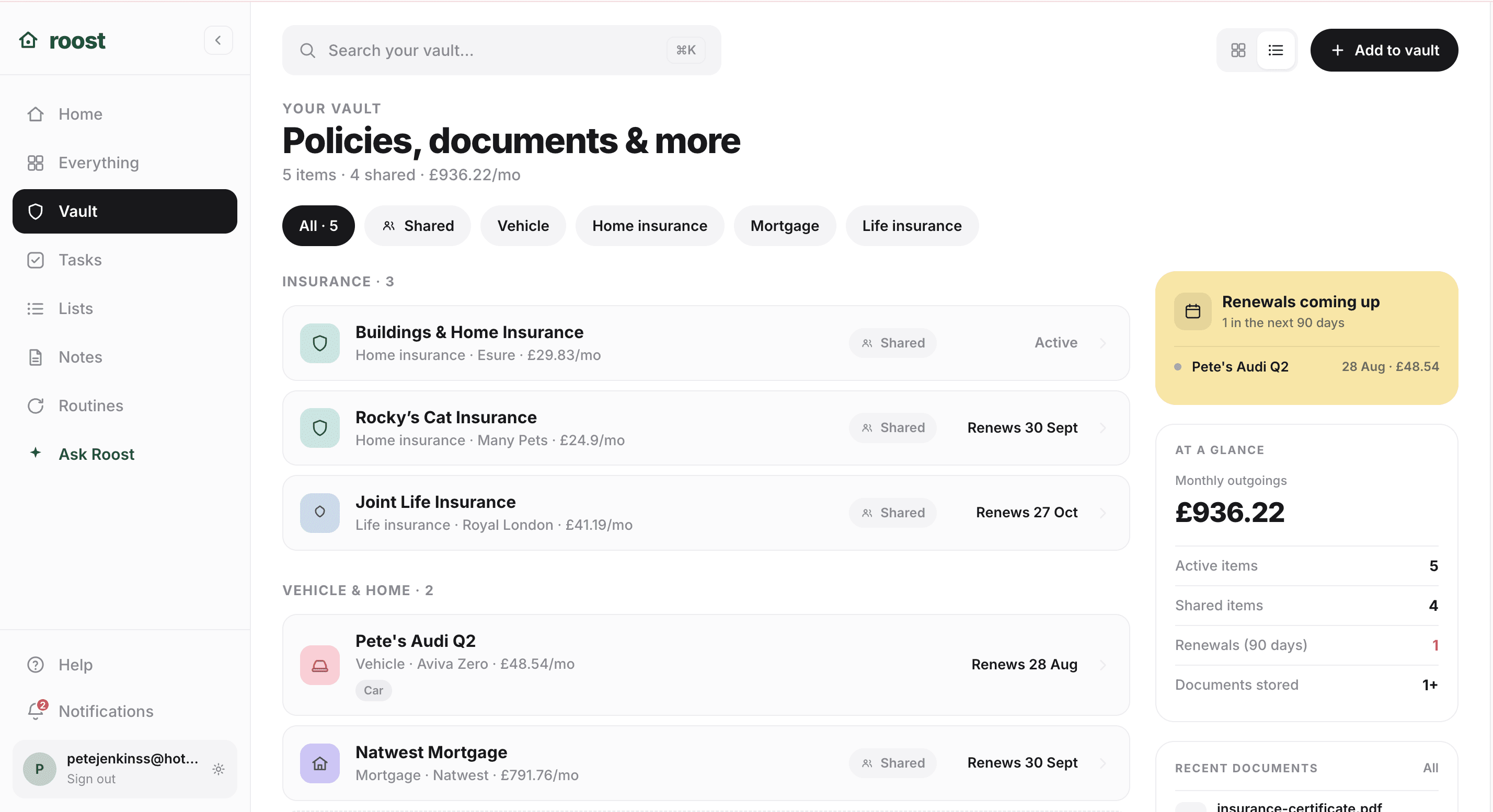
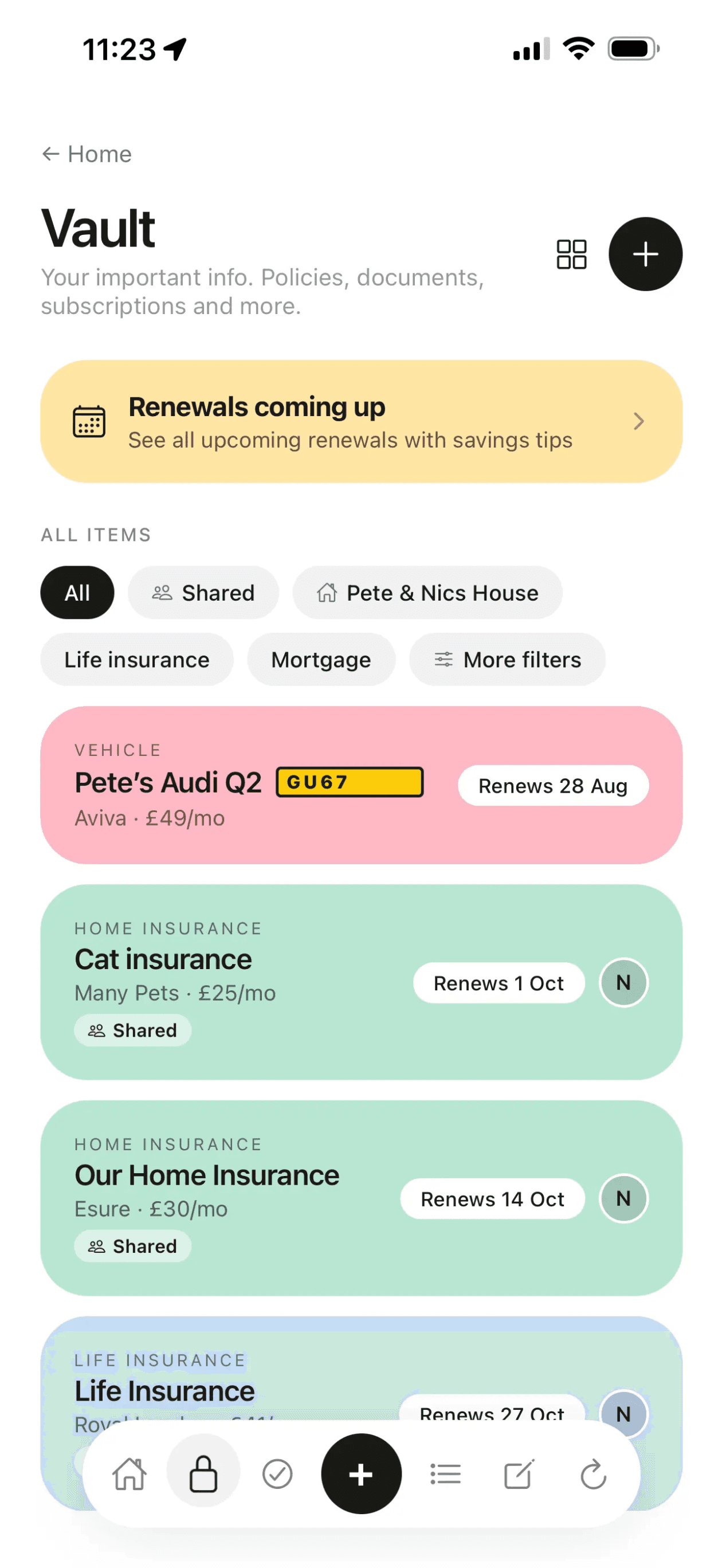
Here is what the property details from a moving house checklist look like once they are stored in Roost, accessible to both people in the household from the first day:
10. Meter readings at both properties
Take gas and electricity readings at the old address and the new address on moving day. At the old address, these form the basis of your final bill. At the new address, they are your opening readings and protect you against being charged for the previous occupant's usage. Take a photo of each meter: the timestamp confirms the date if there is a billing dispute later.
The admin your moving house checklist UK probably misses
These four tasks are among the most commonly left off a moving house checklist, and each has a meaningful consequence if skipped.
11. Update your car insurance address
Car insurance premiums are partly rated by postcode. Moving to a different area changes your risk profile. More importantly, failing to update your address with your insurer is a material misrepresentation: if you make a claim while insured at the wrong address, the insurer can reduce or refuse the payout. Update your car insurer immediately after moving, not at the next renewal.
12. Register on the electoral roll at the new address
Electoral registration is local authority specific. Moving means re-registering with the new authority. Unregistered voters have a thinner credit file: credit reference agencies use the electoral roll as an identity verification check. Registering at the new address also enables you to vote in local elections for the area you now live in.
Notify HMRC
If you are employed, HMRC will eventually update your address from PAYE records. If you are self-employed, a director, or have a personal tax account, notify HMRC directly. A stale address means tax correspondence, including penalty notices, goes to the old address. Update via your personal tax account at gov.uk.
Update your GP and dentist
GP practices in England are registered by catchment area. Moving out of catchment means re-registering with a practice near the new address, which can take time. Start in the first week rather than when you need an appointment. NHS dental practices are also locally registered. Check whether your current dentist can keep you as a patient.

Complete moving house checklist UK by category
Here is the full moving house checklist UK admin, organised by category with timing and the consequence of missing each one.
| Task | When | If you miss it |
|---|---|---|
| Royal Mail redirect | Before you move | Post goes to old address; missed bills and ID risk |
| Bank and building society | 2 weeks before or just after | Address mismatch affects credit checks |
| Home insurance (new address) | Before exchange if buying; before move if renting | Claim at new address may be invalid |
| Car insurance address | Immediately after moving | Material misrepresentation; payout risk on claims |
| DVLA: driving licence | Within weeks of moving | Fine of up to £1,000 |
| DVLA: V5C (vehicle log book) | Within weeks of moving | MOT reminders go to wrong address |
| Council tax: old authority | Before you move | Billed at old address after leaving |
| Council tax: new authority | On or before moving day | Liability starts from move-in date |
| Utilities: old address (close) | Before you move | Bills continue after leaving |
| Utilities: new address (open) | Before you move | Supply gap or billing on previous occupant's account |
| Meter readings: both addresses | Moving day | Opening balance disputes with energy suppliers |
| HMRC | Within weeks of moving | Tax correspondence to old address |
| Electoral register | Within weeks of moving | Cannot vote locally; thinner credit file |
| GP and dentist | First week after moving | Out-of-catchment delays if you need an appointment |
| Employer and payroll | Before or just after moving | P60 and payslips go to old address |
| Stop valve location | Moving day | Cannot turn off water quickly in a leak |
| Fuse board location | Moving day | Cannot isolate circuits in a fault |
| Boiler details | Moving day | No service record; gaps in emergency cover |
Renting vs buying: what changes on your moving house checklist
The moving house checklist UK admin applies to both renters and buyers, but with some differences in responsibility and what happens on day one at the property.
If you are buying
Buildings insurance must be in place from exchange of contracts, not completion day. If the property is damaged between exchange and completion, the buyer's buildings insurance covers it. Stamp Duty Land Tax (SDLT) is due within 14 days of completion; your conveyancer typically handles this, but confirm it has been filed. You will receive your title deeds reference from the Land Registry. Store it somewhere accessible.
If you are buying with a mortgage, the lender will require buildings insurance to be in place before releasing funds. Keep the policy document and schedule accessible from the first day. Your mortgage lender may need a copy.
If you are renting
Before you move in, your landlord must provide a current gas safety certificate, an Energy Performance Certificate, and the government's How to Rent guide. Check that your deposit has been protected in one of the three government-approved schemes: DPS, mydeposits, or TDS. The landlord has 30 days from receiving your deposit to register it. Ask for the scheme reference number.
Take a dated photo record of the property's condition on move-in day. This is your evidence if there is a deposit dispute at the end of the tenancy. Note any existing damage in writing to the landlord on that day.
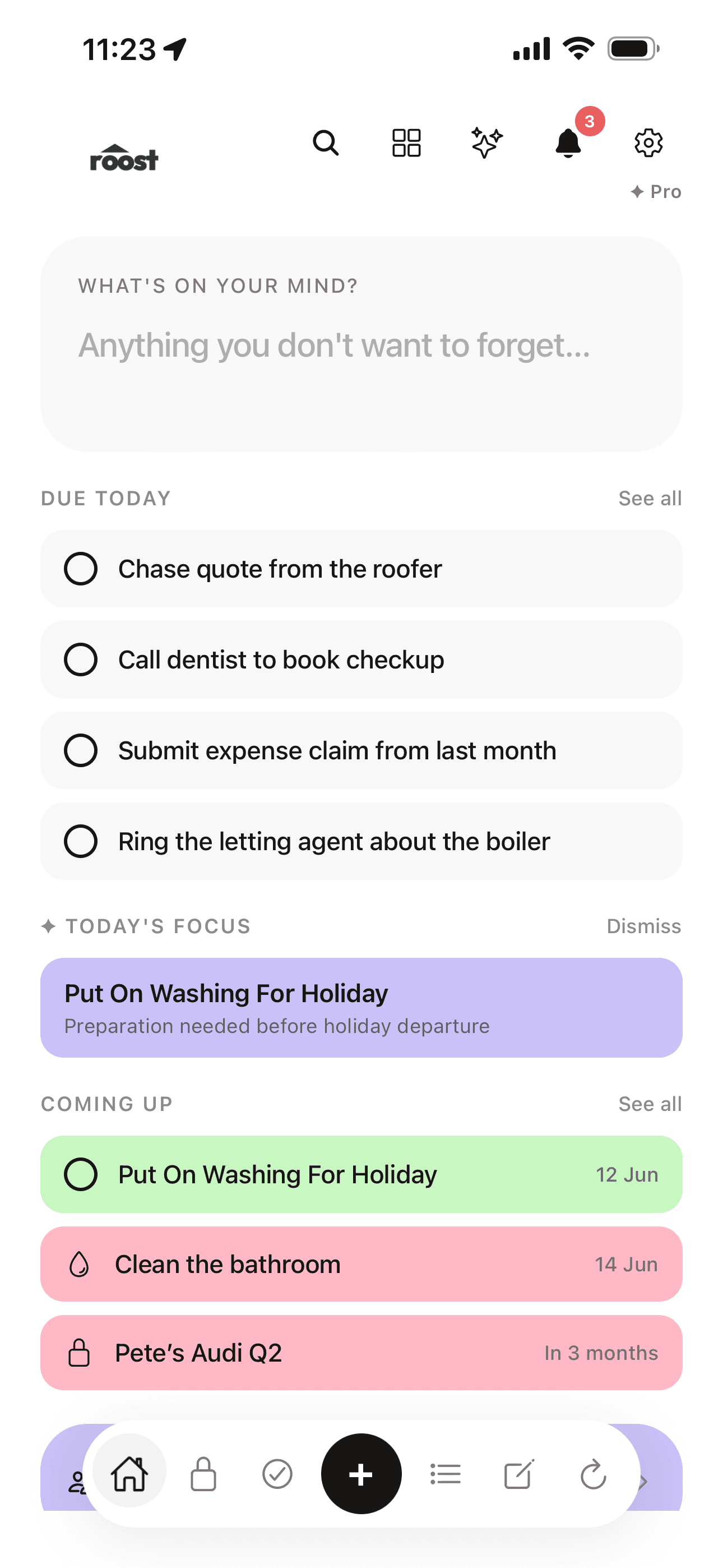
Here is what the household looks like in Roost after completing the moving house checklist (vault entries for the property, renewal dates set up at the new address, and all household information shared between both people from the first week):
30 days after moving in: the follow-up checklist
Most moving house checklists end on moving day. These are the tasks to return to in the first month, once the immediate exhaustion has passed.
- Check for refunds from old utility providers. Final bills take three to four weeks to arrive. If you were in credit at the old address, the refund follows, but only if you provided the correct forwarding bank details when you closed the account.
- Confirm the Royal Mail redirect is active. Ask a friend or family member to send a letter to your old address. If it arrives at the new address within a few days, the redirect is working.
- Check that old direct debits have stopped. Review your bank statement to confirm utilities and council tax at the old address have been cancelled and new standing orders at the new address are in place.
- Update breakdown cover address. If your AA or RAC membership or breakdown cover is address-linked, update it. Some patrol response zones are postcode-based and an outdated address can affect how quickly help arrives.
- Check your credit file. After 30 days, log in to a free credit check service and confirm your new address is showing correctly and the electoral roll update has come through. This typically takes 30 to 60 days from registration.

Keep it all in one place.
Roost stores your household details, renewal dates, and emergency info, shared with your partner. Free to start.
Quick recap
- A moving house checklist UK guide should cover admin, not just logistics: address changes, provider notifications, and property details
- Start the admin 4 to 6 weeks before moving day: Royal Mail redirect and utilities cannot easily be back-dated
- On moving day: find the stop valve, fuse board, and boiler; take meter readings at both properties
- Update car insurance and home insurance to the new address immediately: a wrong address can void a claim
- Register on the electoral roll, notify DVLA, HMRC, GP, and council tax at both old and new addresses
- 30 days after moving: check utility refunds, confirm the redirect is working, and review your credit file
Frequently asked questions
What should be on a moving house checklist in the UK?
A UK moving house checklist should cover both admin and logistics. On the admin side: notify DVLA of your new address, update home and car insurance, set up a Royal Mail redirect, notify your bank and employer, register on the electoral roll at the new address, and notify HMRC. On the property side: record the stop valve location, fuse board, boiler details, and meter readings at both properties on moving day.
How far in advance should you start your moving house checklist?
Start the admin on your moving house checklist at least 4 to 6 weeks before moving day. Royal Mail redirects should be set up before you move. Utilities at the new address need to be arranged in advance. Notify your bank, employer, and DVLA in the two weeks before or immediately after moving day. Leaving everything until after the move means some notifications arrive late.
What do you need to update when you move house in the UK?
When moving house in the UK, update your address with: DVLA (driving licence and V5C), HMRC, your bank and building society, your home and car insurer, your employer, your GP and dentist, the electoral register at the new local authority, and any pension providers. Also set up a Royal Mail redirect at the old address and notify utility providers at both properties.
What property details should you record when you move in?
When moving into a new property, record: the location of the main water stop valve, the fuse board or consumer unit, the boiler make and model and last service date, meter readings for gas and electricity on moving day, and the broadband provider and account details. Storing these in a shared household app means both people in the home can find them without searching.
Roost's vault is built for the property details you collect on moving day: stop valve, boiler, insurer contacts, meter numbers. Add them once, share with your household, and they are there whenever you need them. Free to start at getroost.io.