Moving in together means sorting seven practical things before and after the move: council tax, contents insurance, utility accounts, address updates, the electoral register, what to record at the property on day one, and how you will split household bills. Most couples handle the logistics well and the admin badly, not because it is difficult, but because it arrives when everyone is already tired. Roost is built for the household details both people need to find, stored in one shared place from the first day.

1. Council tax when moving in together
Council tax is one of the most commonly missed admin tasks when a couple moves in, and one of the most likely to create a retrospective bill if ignored.
If one person is moving into a property where the other already lives alone, the single person discount of 25 per cent must be removed from the date the second person moves in. Notify the local authority promptly. If you do not, the council will eventually discover the change and bill for the difference going back to the date of change.
If you are both moving into a new property together, you register for council tax jointly. Both names can appear on the account, which makes both people jointly liable for the bill. Check which council tax band the property is in before you move. You can challenge the band if you believe it is wrong, and a successful challenge reduces every future bill.
Students are exempt from council tax. If one partner is a full-time student and the other is not, the non-student partner pays at a 25 per cent discount. If both partners are full-time students, the property is fully exempt. Notify the council with evidence of student status.
2. Contents insurance when moving in together
When combining two households, check whether you both have existing contents insurance policies and when they renew. Two separate policies covering the same address is wasteful; a single joint policy covering the combined contents of both people is almost always cheaper.
Get quotes for a joint policy before your existing policies renew. Providers will ask for the total value of contents: furniture, electronics, clothing, jewellery, and any high-value items. Under-insuring is common. Work through the main categories honestly rather than guessing.
If you are renting, contents insurance covers your belongings but not the building (that is the landlord's responsibility). If you are buying, you need both buildings insurance and contents insurance. Buildings insurance must be in place from exchange of contracts, not completion day.
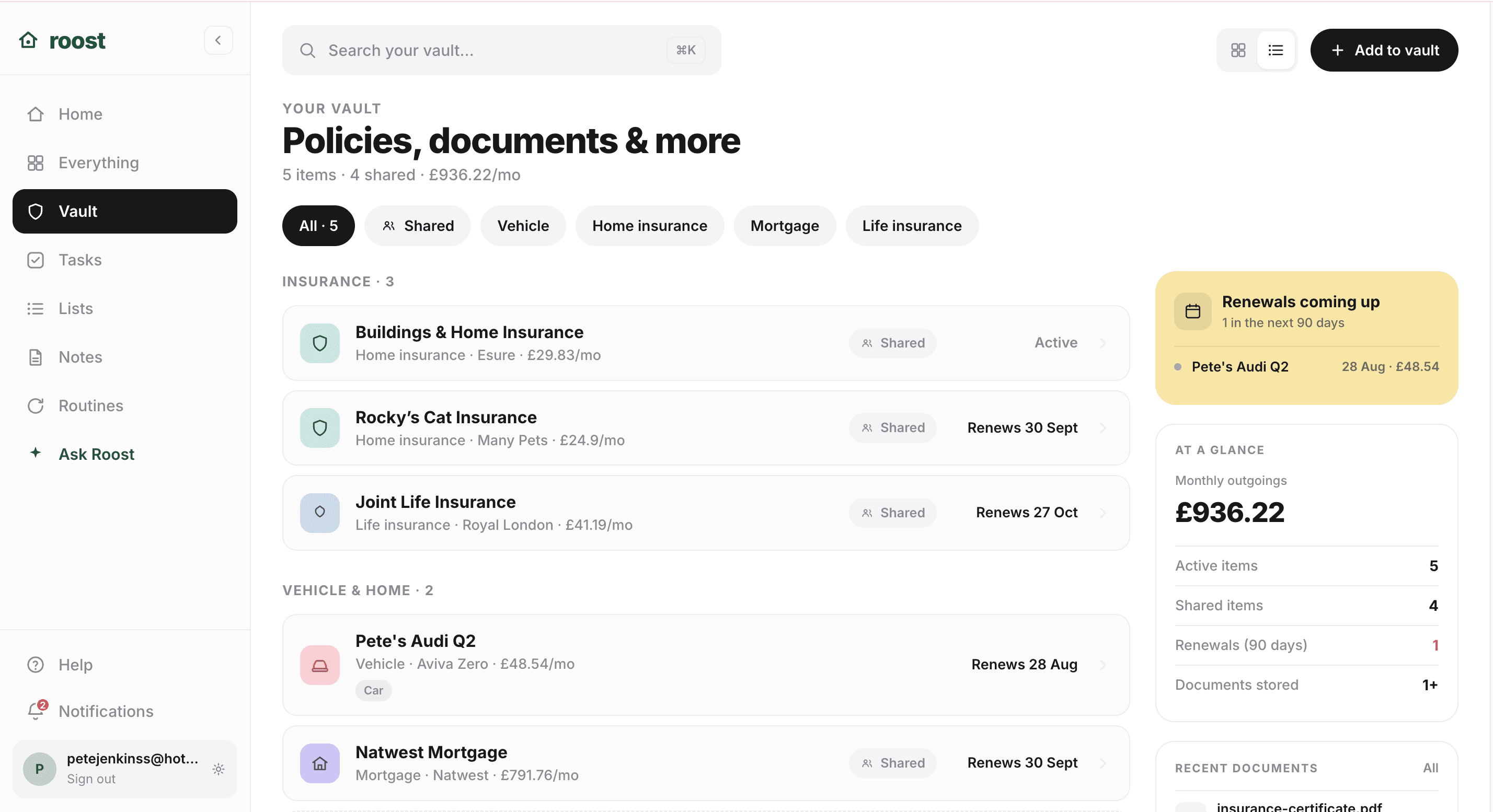
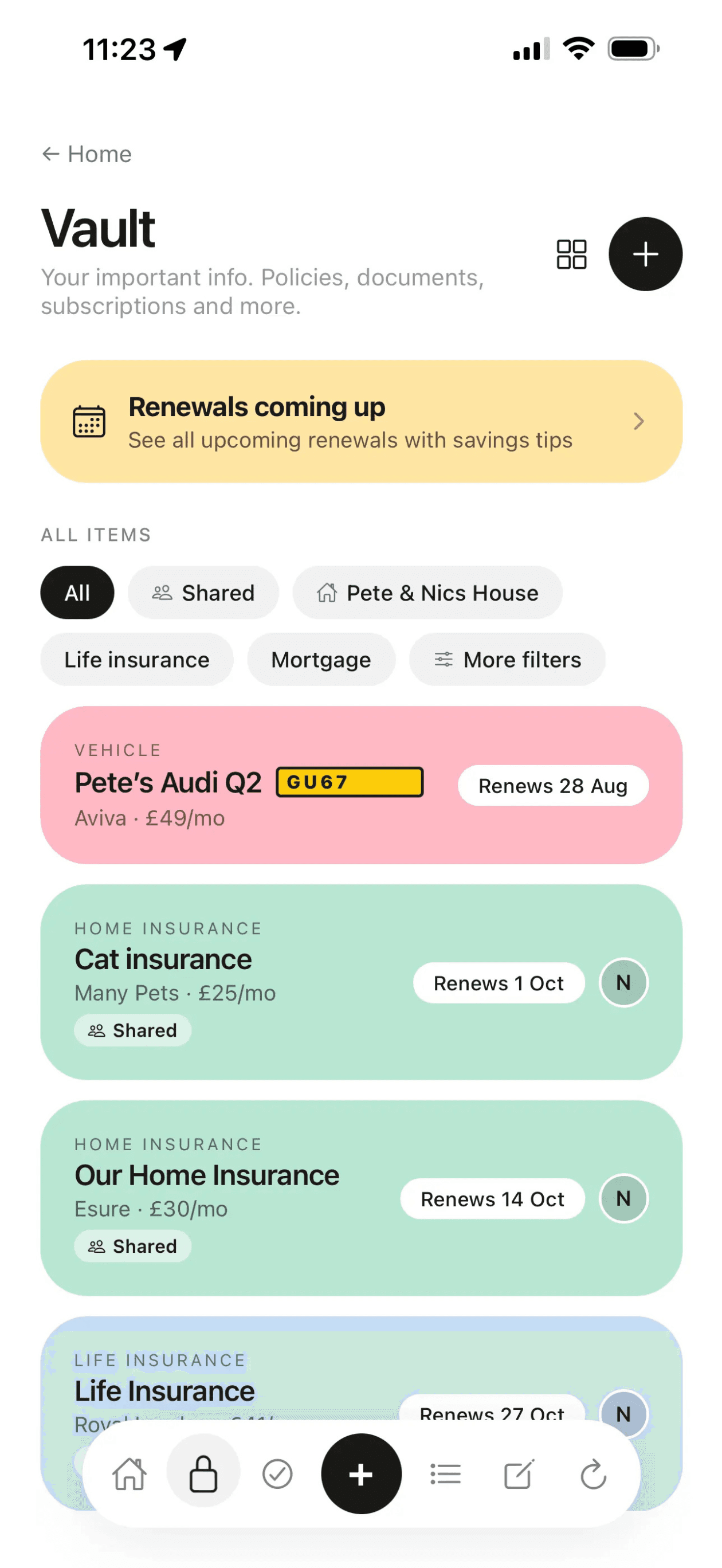
Note the policy renewal date somewhere you will both see it. Insurance auto-renews at an inflated price if you do not actively shop around. Roost's renewals feature lets you set a reminder before the renewal date so you compare before it rolls over.
3. Utilities and broadband when moving in together
Sort utilities in the first week. For energy (gas and electricity), decide whose name the account is in, or add both names if the supplier allows it. Having both names on utility accounts matters if the relationship ends and you need to prove your payment history for a future tenancy reference or credit check.
Take meter readings on moving day and keep a photo with a timestamp. These are your opening readings. Submit them to the energy supplier within the first week so your account starts from the correct baseline. Without opening readings, you may be billed for the previous occupant's usage.
For broadband, check what existing contract is in place at the property. If the previous tenant or owner had a contract, it does not automatically transfer to you; you need to set up a new account. Compare providers before committing: speeds, price, and contract length vary significantly at the same address.
Write down the broadband router password and supplier account number somewhere both people can find them. It is the most frequently needed piece of household information and the most frequently lost.
4. Address updates after you move in
Both people need to update their address with every organisation that holds it. The most common ones missed: DVLA (driving licence and V5C if you own a vehicle), HMRC, bank and building society, GP and dentist, employer payroll, pension providers, and any subscription services.
Updating your driving licence address is a legal requirement. There is a fine of up to £1,000 for not keeping it current. Update via the DVLA online service at gov.uk. If you own a vehicle, update the V5C log book address at the same time. This is where DVLA sends MOT reminders and enforcement notices.
Set up a Royal Mail redirect for your old address if you have one. This costs around £40 for three months and catches any post from organisations you forgot to notify. Particularly useful in the first month when you are working through the list.
5. Electoral register at your new address
Electoral registration is tied to the local authority, not the individual. Moving means both people need to re-register at the new address with the new local authority. This is done online at gov.uk/register-to-vote and takes about five minutes.
Being on the electoral roll at the correct address matters beyond voting. Credit reference agencies use it as an identity verification check. An out-of-date or missing entry can affect your ability to pass a credit check for a mobile phone contract, a new credit card, or a mortgage application. Register within the first week of moving in.
6. What to record at the property when you move in together
Moving in together is the right time to find and record the property details both of you will need at some point. Do this on moving day, when the previous owner or agent may still be reachable to point things out.
- Main water stop valve. Controls the entire water supply to the property. In most UK homes it is under the kitchen sink or near the water meter. Find it, test that it turns, note where it is. You need this immediately in a burst pipe or serious leak.
- Consumer unit (fuse board). Find it, check the circuit labels are accurate, note which switch controls which area. In a power fault or tripped circuit, this is where you go first.
- Boiler details. Note the make, model, last service date, and boiler pressure gauge location. The gas emergency number in the UK is 0800 111 999.
- Meter locations. Both of you should be able to take a reading independently, which is useful when submitting readings to a new supplier or resolving a billing dispute.
- Landlord or managing agent contact. If renting, both people should have the direct contact number, not just the person whose name is on the tenancy.
7. Household finances and splitting bills
How you split bills is a practical decision that benefits from being made explicitly rather than drifting into a pattern that works for one person and not the other.
The three most common arrangements for couples sharing a home:
- Straight 50/50. All shared costs split equally. Simple to track, can feel unfair if there is a significant income difference.
- Proportional to income. Each person contributes the same percentage of their take-home pay. More equitable in principle, requires agreement on what counts as a shared cost.
- One person pays, the other transfers. One account handles all the direct debits; the other person makes a regular transfer. Simpler than a joint account for some couples, but relies on the transfer happening on time.
A joint bank account for shared bills is worth considering. Both people can see what has been paid, neither carries the administrative load alone, and disputed charges are visible to both. Most couples use a joint account for bills while keeping personal accounts for everything else.
One practical note: opening a joint bank account links your credit files. Your partner's credit history becomes visible to lenders when you apply for anything together. Check each other's credit reports before opening a joint account if you plan to apply for a mortgage in the next year or two.

Cohabitation agreements: do you need one?
A cohabitation agreement is a legal document that sets out what each person owns and what happens to property and finances if the relationship ends. It is not a romantic document, but it is a practical one, particularly if one person owns the property, one person is contributing more to a deposit, or financial contributions to the household are significantly unequal.
Cohabiting partners in England and Wales have very limited legal rights over each other's property compared to married couples. There is no such thing as a common law spouse in English law. If one partner owns the property and the relationship ends, the other partner has no automatic right to a share of it, regardless of how long they lived there or how much they contributed to bills or improvements.
A cohabitation agreement, drawn up by a solicitor and signed by both parties, sets out what each person owns and what both parties have agreed. The cost varies by complexity, but most straightforward agreements cost between £300 and £800 through a solicitor. Once you have one, store a copy somewhere both people can find it alongside your tenancy agreement and insurance documents.
What to store together from day one
Moving in together generates a set of household information that both people need and neither should have to ask for. Stored in one place from the start, it saves weeks of where-is-the-X conversations over the next few years.
| Category | What to record |
|---|---|
| Energy | Supplier name, account number, meter reading on move-in day |
| Broadband | Provider, account number, router password, contract end date |
| Contents insurance | Insurer, policy number, renewal date, claims number |
| Council tax | Local authority, reference number, band |
| Tenancy or mortgage | Landlord or lender contact, monthly payment, renewal date |
| Property | Stop valve location, fuse board location, boiler make and last service date |
| Emergency | Landlord out-of-hours number, emergency plumber, gas emergency: 0800 111 999 |
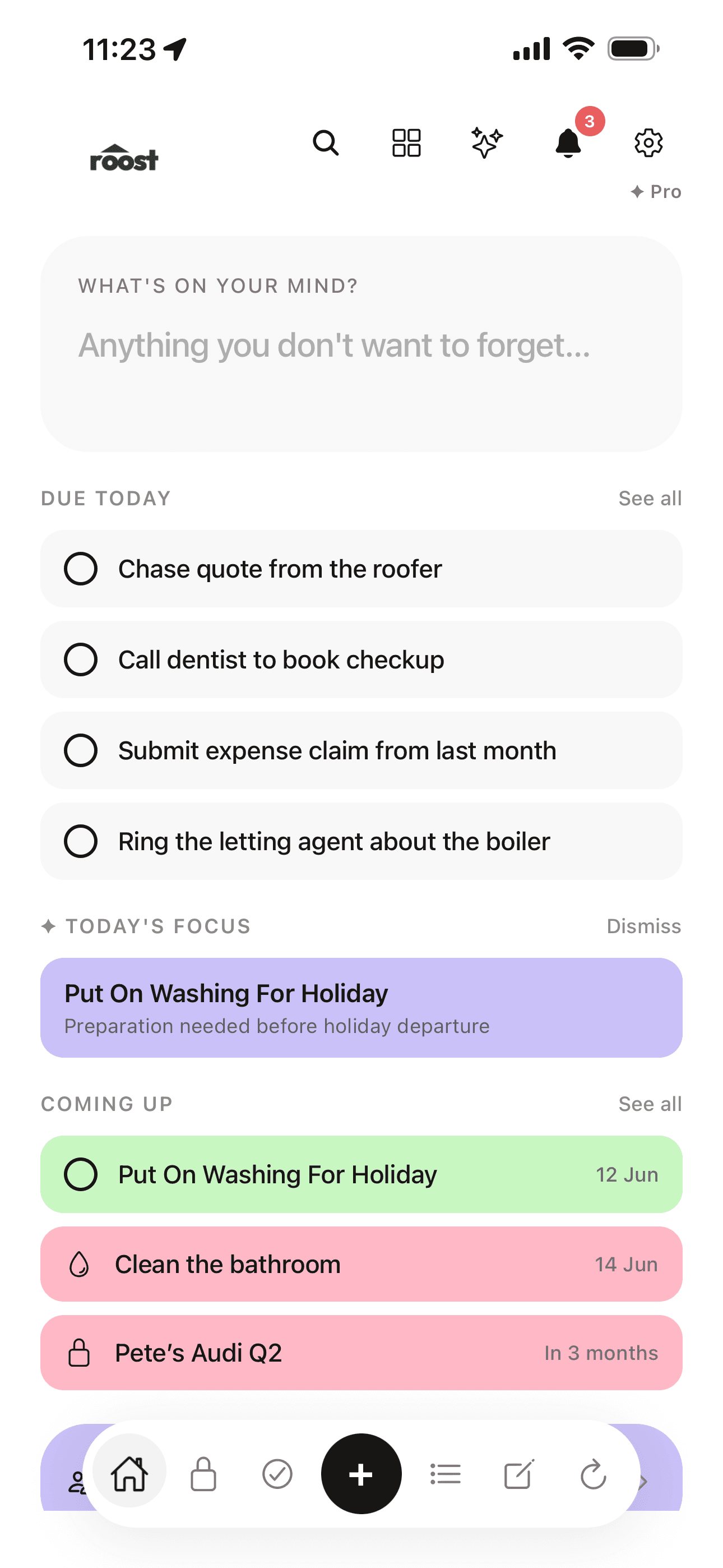
Keep it all in one place.
Roost stores your household details, renewal dates, and emergency info, shared with your partner. Free to start.
Quick recap
- Moving in together means sorting 7 admin tasks: council tax, contents insurance, utilities, address updates, electoral register, property details, and bills
- Notify the council when the second person moves in: the 25 per cent single person discount must be removed from that date
- Take meter readings on moving day and submit them within the first week to avoid being billed for the previous occupant's usage
- Update DVLA, HMRC, bank, GP, and electoral register within the first two weeks; DVLA is a legal requirement with a fine of up to £1,000
- Record stop valve, fuse board, and boiler details on moving day while the previous owner or tenant can still show you
- Agree how you will split bills before moving in, not after; most financial friction comes from unclear expectations
Frequently asked questions
What admin do you need to sort when moving in together?
When moving in together, sort these seven things: notify the council of the change in occupancy for council tax, combine or update contents insurance, put both names on utility accounts, update your address with DVLA, bank, HMRC, and GP, update the electoral register at the new address, record the stop valve and boiler details on day one, and agree how you will split household bills.
How does council tax work when you move in together UK?
If one person moves into a property where the other already lives alone, the single person discount of 25 per cent must be removed. Notify the local council when the second person moves in. If you are both moving into a new property together, register for council tax jointly. Failing to notify the council means you may owe the difference retrospectively.
Do you need a cohabitation agreement when moving in together in the UK?
A cohabitation agreement is not legally required but is worth considering, particularly if one person owns the property or contributes more to a deposit. Unlike married couples, cohabiting partners have very limited legal rights over each other's property if the relationship ends. A cohabitation agreement, drawn up by a solicitor, sets out what each person owns and what happens if you separate.
Should you get a joint bank account when moving in together?
A joint bank account for household bills is practical when moving in together: it keeps shared expenses separate from personal spending and makes it easy to see what has been paid. It does not need to replace your individual accounts. Most couples use a joint account for bills and rent while keeping personal accounts for everything else. Note that a joint account links your credit files.
Roost is built for exactly this: two people, one household, all the admin in one shared place. Both people can see the broadband password, the energy account number, the insurance renewal date, and the boiler details without asking each other. Free to start at getroost.io.