A household organiser is a single place, digital or physical, where every adult in the home can find the information they need without asking anyone else. For most UK households, that means seven categories: insurance and renewals, property details, vehicles, emergency contacts, important documents, subscriptions, and a home maintenance record. Most homes have most of this information somewhere; the problem is that it lives across email inboxes, kitchen drawers, and one person's memory. Roost is a UK-built app designed for exactly this, covering all seven categories in a shared digital vault, free for households to use together.
1. Insurance and renewals
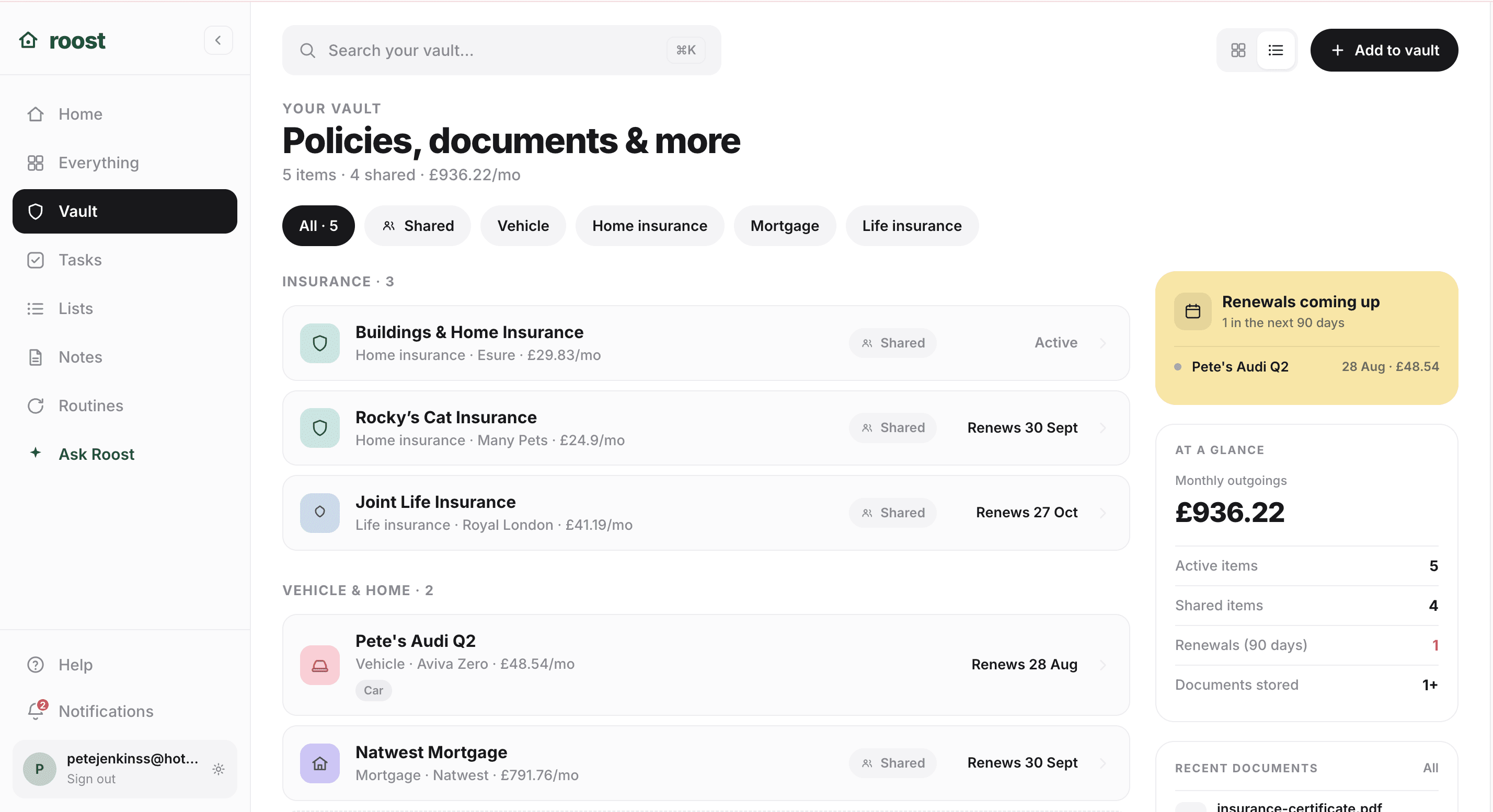
Insurance is the most time-sensitive category to get sorted first because policies auto-renew, often at a significantly higher price than the previous year, unless you actively compare and switch. Having renewal dates in one place, with a reminder set a few weeks before each one, is the difference between paying a fair price and paying the loyalty penalty.
For each insurance policy, record: the insurer name, policy number, what is covered, the annual premium, the renewal date, and the claims helpline number. The claims number is the one you need at the worst time; it should not require searching through an email inbox at midnight after a break-in.
| Policy type | What to record |
|---|---|
| Buildings insurance | Insurer, policy number, sum insured, renewal date, claims number |
| Contents insurance | Insurer, policy number, sum insured, renewal date, claims number |
| Car insurance | Insurer, policy number, renewal date, claims helpline, named drivers |
| Life insurance | Insurer, policy number, sum assured, nominated beneficiary, where documents are kept |
| Travel insurance | Insurer, policy number, single trip or annual, medical exclusions |
| Pet insurance | Insurer, policy number, renewal date, vet claim line |
| Private health | Insurer, membership number, what is covered, claims process |
2. Property details in your household organiser
Property details are the most urgent category to set up because they are needed most often in emergencies. If a pipe bursts at 10pm, you need to know where the stop valve is. If the power trips, you need to know where the fuse board is. These are not things to look up; they are things to already know.
- Main water stop valve location. Controls the entire water supply to the property. Usually under the kitchen sink or near the water meter. Test it turns freely.
- Consumer unit (fuse board) location. Note which circuit controls which area of the property. The labels are often inaccurate and worth checking.
- Boiler details. Make, model, last service date, service engineer contact, and boiler cover provider if you have one. Gas emergency number: 0800 111 999.
- Meter locations. Gas and electricity meter locations, and the meter serial numbers, which are needed when switching supplier or disputing a bill.
- Landlord or managing agent. Name, contact number, and out-of-hours number if renting. Both people in the household should have this, not just one.
- Mortgage lender. Lender name, account number, and the overpayment terms if you make ad hoc payments.
3. Vehicles
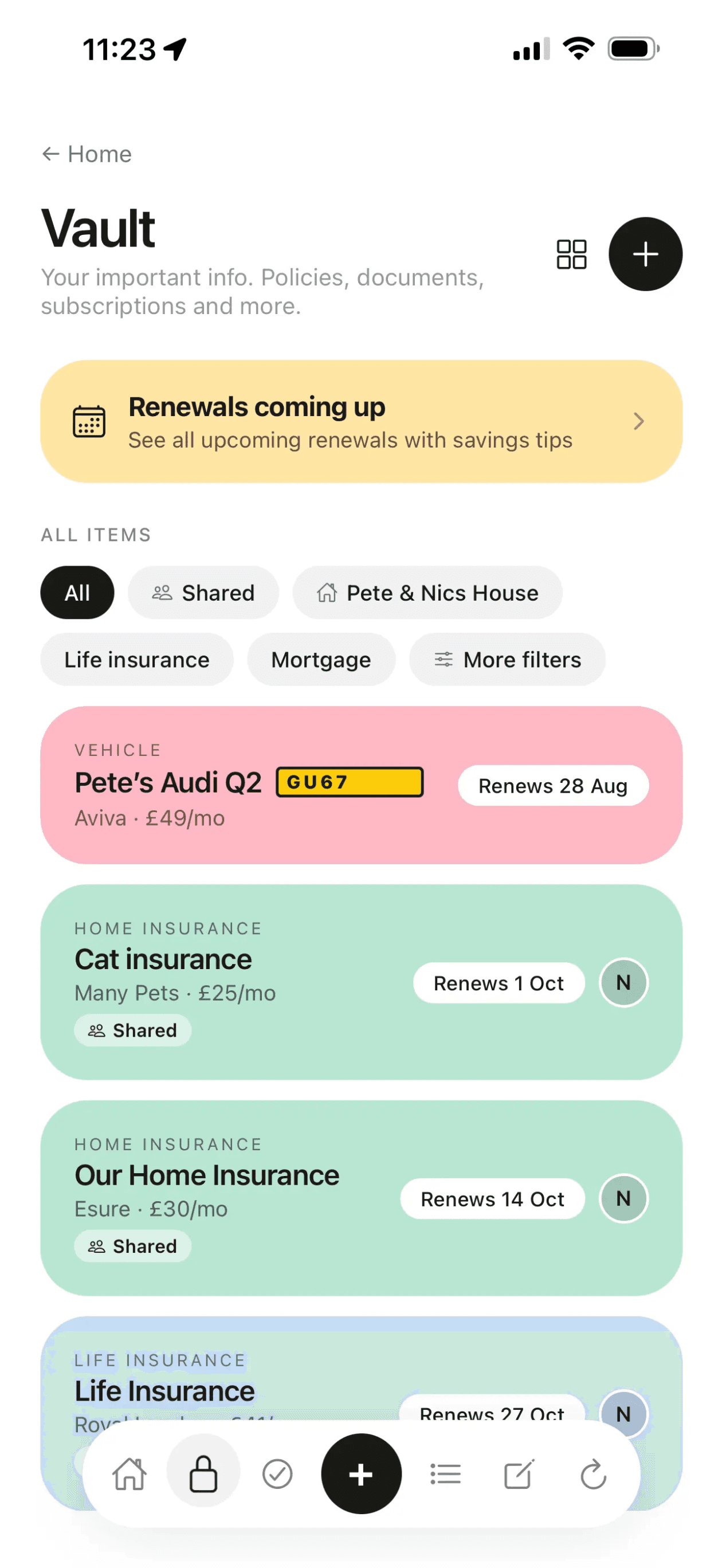
Vehicle admin has the most time-critical deadlines of any household category: an expired MOT means driving illegally; a lapsed car insurance policy means the same. Both are straightforward to avoid with renewal reminders set a month in advance.
- Make, model, registration, and colour for each vehicle
- MOT expiry date: reminder set 4 weeks before
- Service due date or mileage
- Car insurance: insurer, policy number, renewal date, claims helpline
- Breakdown cover: provider, membership number, callout number (AA: 0800 887 766, RAC: 0330 159 0740)
- Finance agreement: lender, monthly amount, settlement figure if relevant
- Garage contact for servicing and MOT
4. Emergency contacts
Emergency contacts are the numbers you need before an emergency happens, not ones you search for during it. A household that has these to hand handles emergencies faster and more calmly than one that starts Googling at the worst moment.
| Situation | Who to call |
|---|---|
| Gas leak or smell | National Gas Emergency: 0800 111 999 (free, 24hr) |
| Power cut | Your distribution network operator: find via energynetworks.org |
| Water leak or burst pipe | Your water company's emergency line |
| Boiler breakdown | Your boiler cover provider's callout number |
| Plumbing emergency | Local emergency plumber: find and save before you need one |
| Electrical fault | Local emergency electrician: save a trusted contact in advance |
| Medical emergency | 999 for emergencies; 111 for urgent non-emergency medical |
5. Important documents
The documents section should track where important documents are stored, not necessarily contain the documents themselves. Knowing that your passport is in the top drawer of the bedside table and expires in March 2027 is more useful than a scanned copy buried in a cloud drive no one can navigate.
- Passports. Expiry dates for every household member. UK passports now need to have at least 6 months validity for many international destinations. Check before booking travel.
- Driving licences. Expiry dates (the photocard expires every 10 years). DVLA address must match your current address.
- National Insurance numbers. Useful for tax queries, benefit claims, pension tracing, and employment admin. Worth having written down somewhere accessible rather than hunting for the original card.
- Wills and lasting power of attorney.Location of the original documents, who the executor is, and the solicitor's contact details.
- Tenancy agreement or mortgage documents. Where they are stored and key terms: notice period, renewal date, early repayment charge.

6. Subscriptions and memberships
Subscriptions are one of the most undertracked categories in any home admin system. Research by Barclays found that UK consumers underestimate their subscription spend by an average of £133 per month. Having them all listed in one place makes it straightforward to spot what is being used, what has been forgotten, and what is renewing at a price worth comparing.
- Streaming services (Netflix, Disney+, Spotify, Apple TV+ and similar): monthly cost, which account pays
- Software subscriptions: antivirus, cloud storage, Adobe, Microsoft 365
- Gym or club memberships: monthly or annual, notice period to cancel
- Magazine or newspaper subscriptions
- Annual memberships: National Trust, English Heritage, zoo, museum passes
- Amazon Prime, Costco, or similar annual memberships with renewal dates
For each subscription, note the provider, the monthly or annual cost, the renewal date, and which bank account or card it charges. This makes auditing straightforward and means you can cancel anything before it renews rather than after.
7. Home maintenance record
A home maintenance record serves two purposes: it reminds you when things are due, and it creates a service history that is genuinely useful when selling a property, making a warranty claim, or disputing a service charge.
- Boiler service. Date of last service, engineer name, next service due. Annual servicing is recommended and maintains warranty validity.
- Gas safety certificate. Required annually if you are a landlord. Date of last certificate and expiry.
- Electrical installation condition report (EICR). Required every 5 years for rented properties. Date and result.
- Smoke and CO alarm tests. Date last tested. Smoke alarms should be tested monthly; CO alarms checked annually.
- Gutter and roof check. Date last inspected, any issues noted.
- Appliance warranties. Make, model, purchase date, warranty end date for each significant appliance.
Digital vs physical household organiser
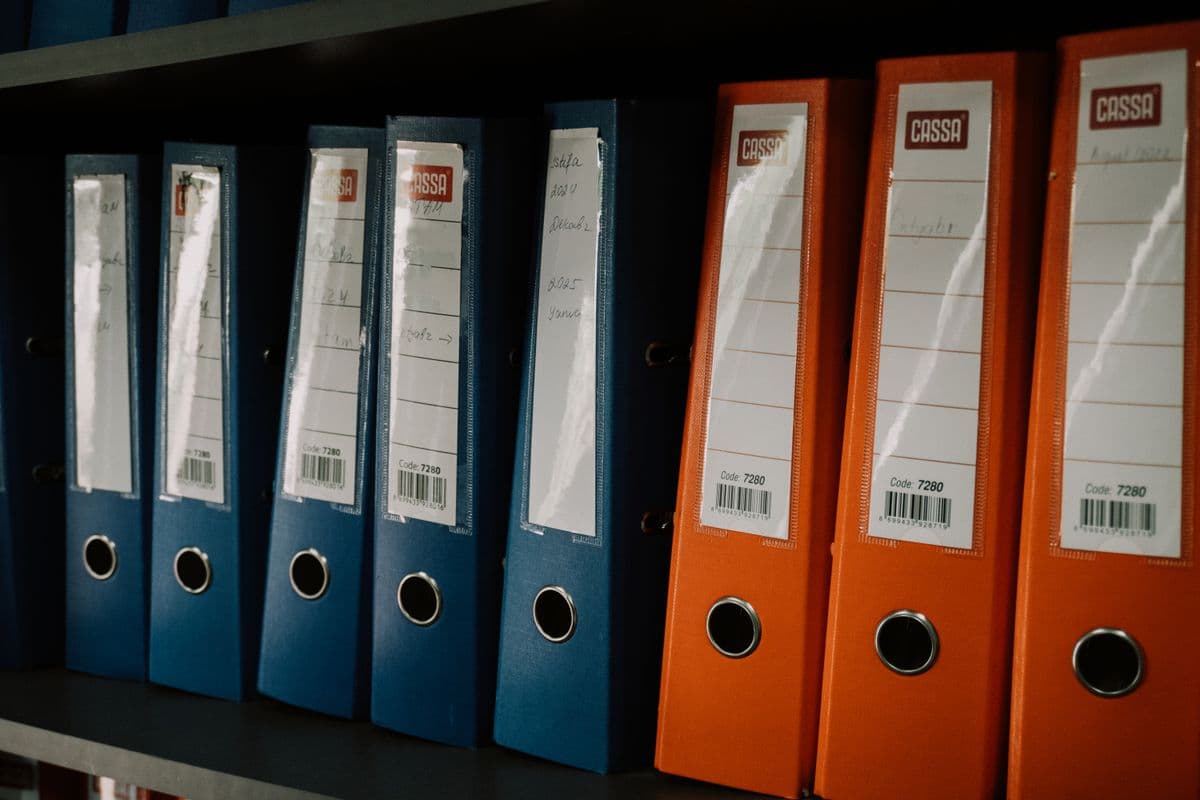
A physical system, typically a binder with labelled sections, works well for storing original documents alongside notes. It requires no technology and is accessible to anyone who can find it. The limitations: it cannot send renewal reminders, cannot be accessed remotely, and is only as useful as the person who remembers to update it.
A digital system solves the sharing problem and the reminder problem. Both people in a household can see the same information, renewals can trigger notifications, and the contents are accessible from anywhere. The limitation is the same as any digital system: it needs to be set up and kept current.
Most UK households benefit from a combination: a digital organiser for account details, renewal dates, and emergency contacts, with original documents stored physically in a known location that is recorded in the digital system.
Household organiser for couples and families
The biggest practical problem is not building a household organiser; it is making sure both people in the household can access it. A well-organised filing system that only one person knows about is an improvement on chaos, but it still creates a single point of failure. If that person is unavailable (travelling, unwell, or the relationship ends), the household cannot function independently.
A shared system means both adults have the boiler engineer's number, both know where the stop valve is, and both can find the contents insurance claim line without asking. This is the core idea behind Roost: household information organised in one place and shared freely between everyone who lives there.
Keep it all in one place.
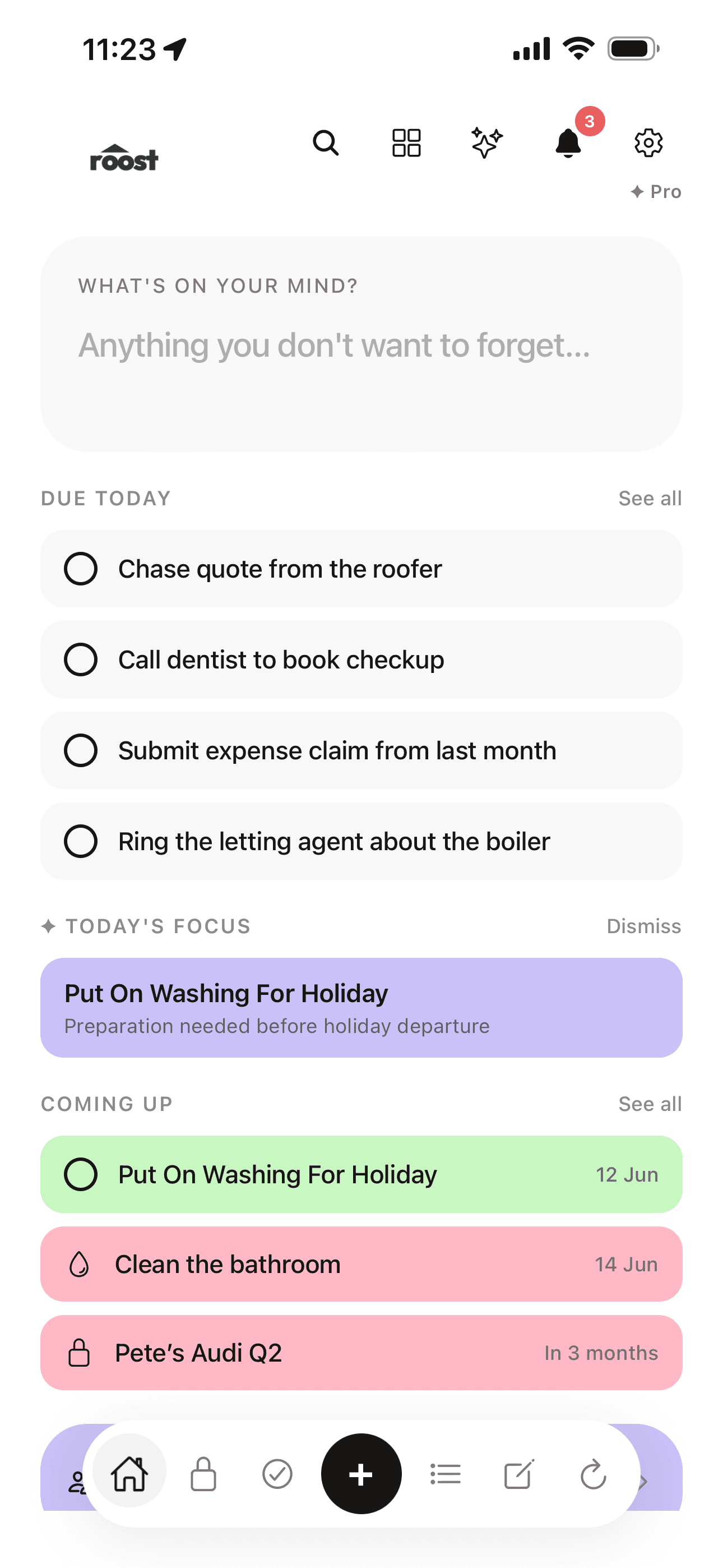
Roost stores your household details, renewal dates, and emergency info, shared with your partner. Free to start.
Quick recap
- A household organiser covers 7 categories: insurance renewals, property details, vehicles, emergency contacts, important documents, subscriptions, and a maintenance record
- Insurance renewal dates with advance reminders stop auto-renewal at inflated prices: the single highest-value habit to build
- Property emergency details (stop valve, fuse board, boiler, gas emergency number) should be recorded before you need them
- UK consumers underestimate subscription spend by £133/month on average; a full subscription audit is worth doing once a year
- A digital system solves the sharing problem: both people can access renewal dates, account numbers, and emergency contacts from anywhere
- The best household organiser is one both people actually use, not one only one person maintains
Frequently asked questions
What should a household organiser contain?
A household organiser should contain seven categories: insurance policies and renewal dates, property details (stop valve, boiler, fuse board), vehicle records, emergency contacts, important documents, subscriptions and memberships, and a home maintenance schedule. The goal is that any adult in the household can find critical information without asking anyone else.
What is the best household organiser for the UK?
The best household organiser for UK homes is one that both people in the household can access and update. Roost is a UK-built app designed specifically for household admin: it covers insurance renewals, property details, shared lists, and home maintenance reminders, with free sharing for households. Physical binders work for document storage but cannot send renewal reminders or be accessed remotely.
Should a household organiser be digital or physical?
A digital household organiser is more practical for most households. It can be shared with a partner or family member, sends renewal reminders, and is accessible remotely (useful when you need your home insurer's number while away from home). A physical binder is useful for storing original documents alongside digital records, but should not be the only copy.
How do I set up a household organiser?
Set up a household organiser by working through seven categories one at a time: start with insurance (the most time-sensitive due to renewals), then property details, vehicles, emergency contacts, important documents, subscriptions, and home maintenance. Add the information as you find it rather than trying to complete everything in one session. Share access with everyone in the household from the start.
Roost is a UK household organiser built for couples and families: seven categories, free sharing with your household, renewal reminders, and emergency contacts in one place. Free to start at getroost.io.